Why Water Is the Key
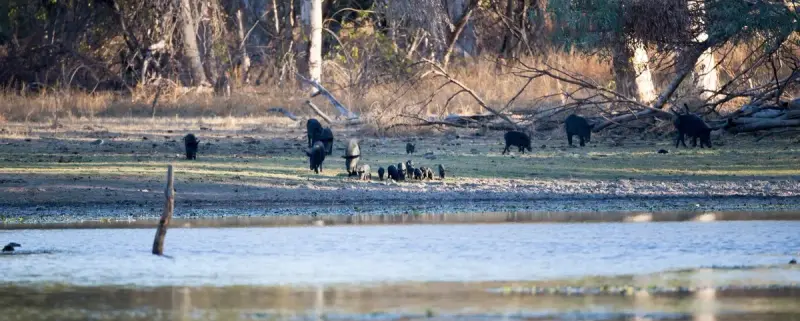
If you are trying to find feral pigs, start at the water.
According to PestSmart biology guidance, feral pigs lack sweat glands, are relatively heat intolerant and need free water and shade to cope with high temperatures. The National Feral Pig Action Plan FAQs state that pigs prefer living near water sources and may need water twice daily in hot weather. Their distribution is closely tied to watercourses, floodplains, available feed and cover.
NSW Government environment guidance says feral pigs prefer wetland, floodplain and watercourse environments. That is why creek flats, river bends, dams, wallows and shaded drainage lines often carry the heaviest pig activity on a property.
As conditions dry off, pigs tend to gather closer to reliable water. The PIGOUT and HOGGONE product labels both note that pigs concentrate near water sources during autumn or the local dry season when feed becomes harder to find. National guidance for 1080 baiting also notes that pigs are concentrated around permanent water points when surface water is scarce and pastures have dried.
For most properties, the same water sources that attract pigs also attract the damage. That is why creeks, rivers and dams are often where control effort delivers the greatest benefit.
The Damage Along Creeks, Rivers and Dams
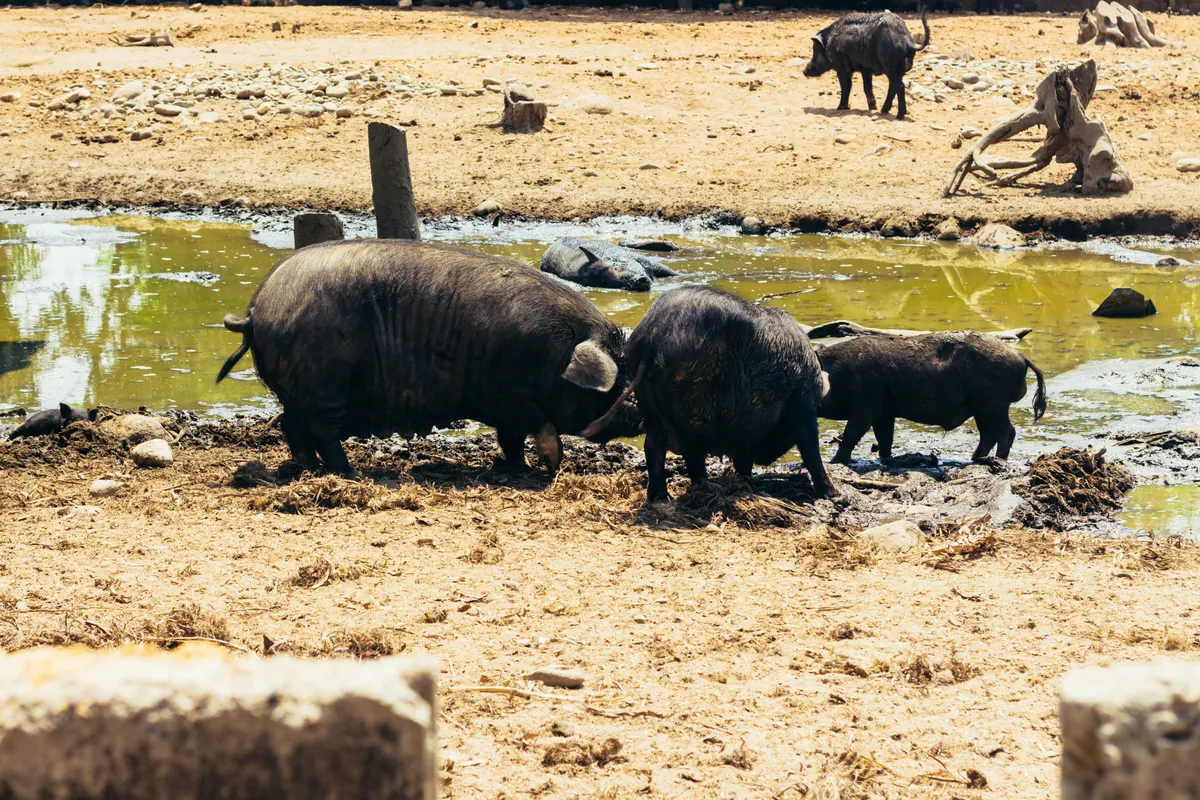
- NSW Government guidance states that pigs can contaminate water sources by wallowing in dams, waterholes and other moist or swampy areas.
- They can create drainage channels in swamps and may destabilise stream banks.
- They can cause soil erosion through digging for food, particularly along drainage lines, around swamps and lagoons and after rain when the ground is soft.
- They eat native plants, selectively overgraze some plant communities and damage vegetation through trampling.
- They prey on native animals including frogs, reptiles, birds and small mammals.
The Queensland Government PA6 fact sheet also notes that rooting activity can weaken dam walls. Around farm dams this can turn a local pig problem into an infrastructure problem.
Research discussed by Waltham and Schaffer found that pig feeding activity can have major impacts on wetland vegetation communities and is associated with soil erosion, sediment disturbance, reduced water clarity and nutrient enrichment.
In 2004, the NSW Scientific Committee listed predation, habitat degradation, competition and disease transmission by feral pigs as a key threatening process, noting their preference for riparian and swampy habitats. Local Land Services has also highlighted the need to reduce feral pig numbers in riverine areas because pigs are known to degrade these systems.
There is also a livestock and human health dimension. NSW Health notes that leptospirosis bacteria can be excreted in urine from infected animals, including pigs, and infections are usually associated with water, soil or mud contaminated by infected urine. Wildlife Health Australia notes that domestic and feral pigs are the main amplifying hosts of Japanese encephalitis virus and that the mosquito species involved favours freshwater areas with heavy vegetation.
What Changes About Control Near Water
The baiting rules
Control near water needs more planning because specific restrictions apply.
Under the NSW Pesticide Control (1080 Bait Products) Order 2020, Schedule 3:
- 1080 feral pig baits must not be placed where they can be washed into or contaminate surface or ground waters.
- They must not be laid within 20 metres of a domestic water supply. The Order defines this by the water draw point supplying domestic use, not the full length of a stream.
- Large storages such as Eucumbene, Wyangala and Chaffey dams must not be ground baited within 10 metres of the waterline.
- If distance restrictions cannot be met, another control method must be used.
- Baits, bait containers and disposal activities must not pollute dams, drains, streams, rivers or waterways.
The PIGOUT and HOGGONE product labels add a separate requirement. This is where the commonly quoted 20 metre setback from creeks and rivers comes from. The PIGOUT label requires baits to be placed at least 20 metres from permanent or flowing water bodies unless otherwise specified by the state or territory. The HOGGONE label similarly states that baits must not be placed within 20 metres of a permanent or flowing water body and that dams, rivers, streams, waterways and drains must not be contaminated.
In practical terms, baiting is generally focused on pads, feeding areas and travel routes set back from the creek bank rather than directly beside water. Areas that could carry water after rain are best avoided. For broader baiting requirements, see understanding 1080 and PAPP bait rules.
Non-target and downstream risks
The NSW 1080 Order states that its minimum distances are intended to minimise risk to people and non-target animals.
- Vomit: National guidance notes that vomit containing 1080 may cause secondary poisoning of non-target species. Dogs are extremely sensitive to 1080.
- Wildlife at the bait: The NSW 1080 Order notes that pig baits may be toxic to some birds and other native wildlife, so bait placement and station design should minimise non-target access.
- Carcasses: The NSW 1080 Order states that poisoned carcasses should be recovered and buried to the extent possible. The PIGOUT label recommends carcass recovery during the campaign and for 14 days afterwards.
PestSmart’s 1080 facts page notes that 1080 is highly soluble and biodegradable and breaks down over time in water, soil and carcasses. The focus near waterways remains keeping baits out of water and following all label and order requirements.
Trapping and Shooting Along Waterways
Trapping often suits creek country because pigs naturally move through the same approaches, crossings and shaded areas. National guidance recommends free feeding at active sites such as watering points, wallows and fence holes before traps are set. Traps should be placed where shade and shelter are available because pigs cope poorly with temperature extremes. All set traps must be inspected daily. NSW Government guidance also notes that livestock should be removed from the trapping area so they do not consume trap feed. Learn more about feral pig trapping.
Shooting is commonly used as a follow-up method. National guidance states that every line of fire must be selected to prevent accidents or injury from stray bullets or ricochets. Around waterways, effort is usually focused on the approaches, pads and wallows that pigs repeatedly use.
The National Code of Practice states that integrated management using a range of techniques produces the best results. That is why trapping, baiting and shooting are often used together rather than relying on a single method. See feral pig control services and how to control feral pigs.
Working With Neighbours Downstream and Upstream
A creek is shared country. PestSmart biology guidance states that family groups of sows, piglets and juveniles may use home ranges of 2 to 20 square kilometres, while boars are typically solitary and may use ranges of 8 to 50 square kilometres. Research cited by Ryan and others reports pig movement along rivers in low-rainfall environments, although the same study found major waterways could act as barriers in north Queensland. The important point is that pig activity often extends beyond a single boundary fence.
If one section of creek is controlled while pigs remain established up or downstream, fresh activity can reappear. Local Land Services advises that pest control is more effective when neighbours work together and can assist groups to plan coordinated activity. The National Code of Practice also recognises that effective control may require collaboration across adjoining properties regardless of tenure. NSW Government guidance notes that pigs readily return to their home ranges. Read more about coordinated neighbour pest control.
After Control: Letting the Banks Recover
The first sign of success is often less fresh activity along the water.
A Local Land Services case study from the Yantabulla Swamp area near Bourke reported that more than 15,000 feral pigs were removed over a two-year period. A landholder involved in the programme described knee-high medics and Warrego summer grass in rested paddocks and reported seeing more birdlife, including nesting chicks, black swans and brolgas. These observations were reported through the case study and should not be treated as measured monitoring results.
Research from Queensland floodplain wetlands found fish communities in fenced and unfenced wetlands were similar. The broader lesson is that environmental responses vary and should not be assumed from a single measure alone.
National guidance highlights the importance of ongoing effort. The National Code of Practice states that at least 70 percent of the population needs to be removed at least annually to prevent rapid population recovery. Keeping numbers down over time is the dependable lever.
After a major knockdown:
- Use trail cameras on creek crossings and wallows to detect returning pigs.
- Photograph the same stretches of bank each season to track visible recovery.
- Report new activity early to Local Land Services and neighbouring landholders.
Sources consulted: NSW Pesticide Control (1080 Bait Products) Order 2020; PIGOUT and HOGGONE meSN product labels; NSW Government environment guidance on feral pigs (2021); NSW Scientific Committee key threatening process determination (2004); National Feral Pig Action Plan FAQs (2021); PestSmart feral pig biology and 1080 fact pages; national standard operating procedures PIG001, PIG003 and PIG004 (2024); National Code of Practice for feral pigs (2024); Local Land Services Yantabulla Swamp case study and riverine project pages; NSW Health leptospirosis fact sheet; Wildlife Health Australia JEV fact sheet (2025); Waltham and Schaffer (2021), Ecology and Evolution; Ryan and others (2023), Ecology and Evolution; Queensland Government fact sheet PA6 (2010).
If pigs are working your creek, river frontage or dam country, talk with us about pig control along your water. We can plan control around the rules, the water and neighbouring properties. Call 0493 417 929.