Feral Animals Cross Fences. Your Control Should Too.
Here is the hard truth about controlling feral animals on your own: it usually does not work for long. You can bait, trap, and shoot every pig, fox, or dog on your place, and within weeks or months the animals from next door move in to fill the space. You end up paying, every season, to refill the same hole. It is expensive, exhausting, and it never gets ahead.
The way to actually get ahead is coordination: neighbouring properties controlling pests across the whole problem area at the same time. This guide explains why isolated control fails, how coordinated group programmes work in NSW, how to start one with your neighbours, and how joining one helps meet your biosecurity duty.
The Reinvasion Problem
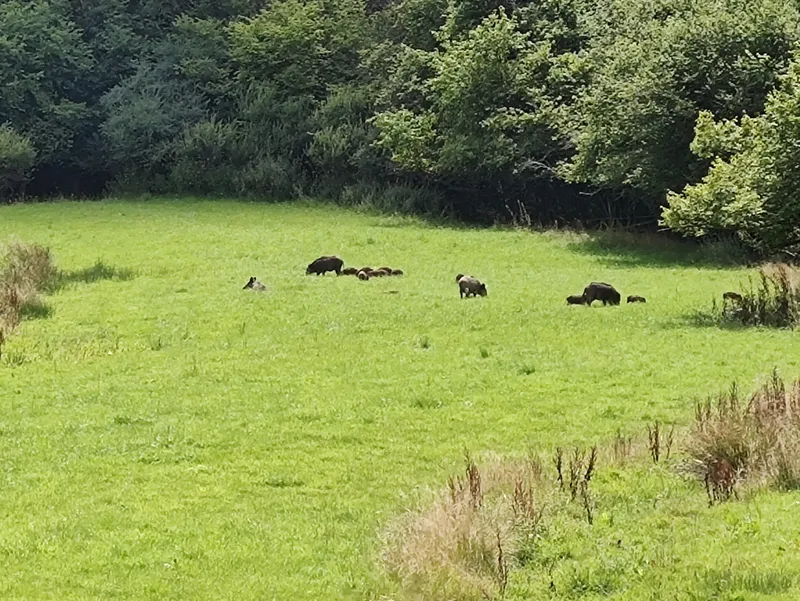
Feral animals move across property boundaries as a matter of routine. Feral pig home ranges run from a couple of square kilometres for a sow group up to 50 square kilometres for a boar, and boars can disperse up to 150 kilometres to find breeding opportunities (PestSmart). GPS tracking of pigs in eastern Australia recorded home ranges up to about 55 square kilometres (Amos and others, 2023). A single pig’s normal range routinely spans several typical NSW properties.
Foxes are the same story from a different angle. They are highly territorial with large territories that ignore your fence line, and when you remove the foxes on your land, young foxes from neighbouring country move straight into the vacant territory. Trials of aerial fox baiting found that when only one area was baited once a year, foxes reinvaded within months, and it took quarterly baiting to hold them down for a full year.
That is the reinvasion problem in a sentence: isolated control creates a vacuum, and the surrounding landscape fills it. As the National Feral Pig Action Plan puts it, localised control at the single-property level is not likely to be effective in the long term, because animals move among sites and recolonise controlled areas rapidly.
Why Coordination Wins
If reinvasion is the problem, treating the whole landscape at once is the solution.
For feral pigs, the arithmetic is stark. The National Feral Pig Action Plan (2021) states you need to remove at least 70 percent of the population every year just to stop it growing, because pigs can increase by up to 86 percent in a good year and a population can double every twelve months. A single property acting alone almost never hits 70 percent across a landscape, because the animals it misses, and the animals next door, refill the gap. A whole district acting together can, because there is no untreated neighbour to reinvade from.
The NSW numbers show what coordination delivers. Through its Feral Pig and Pest Program, Local Land Services controlled more than 83,000 feral pigs and over 15,000 deer in a single year (2024-25), across 41 coordinated aerial programmes and ground control, with more than 9,000 landholders taking part and 18 million hectares covered. Over three years, coordinated programmes have controlled around a quarter of a million feral pigs. At the community scale, a group in the Yarrowitch Valley removed more than 1,500 pigs in two years by working together, and two neighbouring Central Tablelands properties that combined roughly 100 kilometres of fencing with coordinated aerial shooting cut pig traffic by 60 to 70 percent and averted an estimated 150,000 dollars in crop damage.
The same logic drives coordinated autumn wild dog and fox baiting: when every property in a district baits in the same window, foxes and dogs cannot simply shift to an untreated neighbour, and lamb survival rises with the spatial coverage of the programme.
How Coordinated Programmes Work in NSW
Local Land Services coordinates group programmes on a nil-tenure basis. That phrase means the landscape is managed as a single unit rather than parcel by parcel, and control happens across both public and private land so pests have nowhere to retreat. In practice that looks like:
- Coordinated baiting windows. District-wide autumn and spring 1080 baiting, timed to when foxes and pigs are most vulnerable, so the whole area is treated at once.
- Cross-tenure control. Wild dog and fox baiting run alongside national parks, state forests, and travelling stock reserves, in conjunction with Wild Dog Control Associations, across tens of thousands of kilometres of strategic bait lines.
- Coordinated aerial operations. Helicopter shooting across multiple properties and land tenures at once, delivered through the programme rather than hired ad hoc.
- Boundary programmes. The 10 million dollar Good Neighbours Program funds control specifically where private land meets national parks, state forests, and Crown land.
- Group fencing. Neighbours clustering exclusion fences so a shared boundary becomes a shared cost.
How to Start a Programme With Your Neighbours
You do not need to organise a whole district yourself. You need to make two connections: Local Land Services, and the properties around you.
- Call Local Land Services on 1300 795 299 and ask for your local biosecurity officer. They facilitate group programmes and provide the mapping, the plan, and the bait logistics, at no cost.
- Talk to your neighbours. The more adjoining properties involved, the longer the knockdown lasts. Some LLS incentives require a minimum number of neighbouring holdings baiting together, so a few conversations over the fence go a long way.
- Include the public land. If pests are coming from an adjoining park, forest, or reserve, ask about cross-tenure options and the Good Neighbours Program so the boundary is treated too.
- Agree a common timing window. The power of coordination comes from everyone baiting or shooting at the same time, so line up on the district’s autumn and spring dates.
- Get accredited. Complete the free VPIT training online so you can collect and use 1080 baits. See our roundup of free Local Land Services resources for how.
- Use more than one method. Combine baiting, trapping, shooting, and fencing. No single method controls all the animals.
- Record and share results. Log your control through FeralScan so the group can see progress and plan the next round.
Coordination and Your Biosecurity Duty
There is a compliance reason to coordinate as well as a practical one. Under the Biosecurity Act 2015, every landholder in NSW has a general biosecurity duty to take reasonable steps to prevent, eliminate, or minimise the biosecurity risk that pest animals pose. Feral pigs, wild dogs, foxes, and deer are priority pests under the Regional Strategic Pest Animal Management Plans. Taking part in a coordinated Local Land Services programme, and keeping records of your control, is one of the clearest ways to demonstrate you are meeting that duty. Our guide on the biosecurity duty and reasonable steps explains what that looks like in practice.
How We Help
We build our programmes to plug into coordinated control, not to work around it. We start with a property assessment that maps where your pests are coming from, including which boundaries they cross, then design baiting, trapping, and shooting that fits the district’s timing and your Local Land Services programme rather than cutting across it. Where your neighbours are in, we help align the effort so the whole problem area is treated at once. For owners who cannot be on the block themselves, and our guide to absentee and lifestyle landowner pest control covers that position in full, our Absentee-Owner Monitoring keeps the property covered so it is not the unmanaged gap the neighbours have to work around, and for those who want the control run to the district’s timing year-round, the Annual Stewardship and Compliance Program manages it end to end. See our feral pig control page, or get in touch to talk about a coordinated plan for your country and the properties around it.
Sources consulted: National Feral Pig Action Plan 2021-2031 (feralpigs.com.au and PestSmart); PestSmart feral pig biology and coordinated group fox programmes; Amos and others, Wildlife Research (2023), feral pig activity ranges; McLeod and Saunders, Wildlife Research, participatory landscape fox management; NSW Local Land Services and NSW Government (Feral Pig and Pest Program 2024-25, Good Neighbours Program, group control, targeting feral pigs across boundaries); Biosecurity Act 2015 (NSW), section 22; Saunders and McLeod, the impacts and management of foxes in Australia.