The Rabbit Problem in NSW
The European rabbit remains one of Australia’s most destructive pest animals, more than 160 years after their introduction. According to ABARES, rabbits cause an estimated $197 million in agricultural damage annually across Australia, a figure the Invasive Animals CRC and advocacy groups commonly round up to more than $200 million, with NSW bearing a significant share of those losses.
Despite decades of biological control through myxomatosis and calicivirus (RHDV), rabbit populations remain a serious problem across much of rural NSW. Genetic resistance to both diseases is developing, and in years with good rainfall, populations bounce back rapidly. The Central West, Northern Tablelands, Hunter Valley, and North West are all affected.
What damage do rabbits cause?
The impact of rabbits on agricultural land is cumulative and insidious. It builds over time, and by the time the damage is obvious, significant productivity has already been lost:
- Pasture degradation: Rabbits selectively graze the most palatable and nutritious pasture species, gradually degrading improved pastures to less productive weedy compositions. Research from CSIRO estimates that 10 rabbits consume as much pasture as one sheep. A property with 500 rabbits is effectively carrying 50 extra sheep that contribute nothing to your income.
- Soil erosion: Rabbit grazing removes ground cover, and warren construction loosens and disturbs soil. Together, these factors dramatically increase erosion, particularly on slopes, creek banks, and lighter soils. In parts of western NSW, rabbit-induced erosion has caused irreversible land degradation.
- Crop damage: Rabbits graze cereal crops, vegetable plantings, and horticultural crops, particularly during germination and early growth stages. Damage is most severe in paddocks adjacent to timbered areas, creek lines, and rocky outcrops where warrens are established.
- Tree and seedling damage: Rabbits ring-bark young trees and browse seedlings, preventing regeneration of both native vegetation and planted timber. Revegetation programmes are frequently undermined by rabbit grazing.
- Competition with livestock: Rabbits compete directly with sheep and cattle for feed, particularly during dry periods when pasture is scarce. PestSmart research shows that 9 to 12 rabbits per hectare equals one dry sheep equivalent (DSE). During drought, rabbits maintain their population by grazing pastures down to bare soil long before livestock would, leaving nothing for stock.
- Disease and health risks: Rabbits are hosts for dog tapeworms and sheep liver fluke, and may transmit Johne’s disease (Mycobacterium avium paratuberculosis) to cattle. They are also vectors of infective E. coli in humans. Rabbit grazing promotes the spread of Paterson’s Curse, a weed that is toxic to pigs, horses, and cattle.
Population dynamics
Rabbits are extraordinary breeders. A single doe can produce 4 to 7 litters per year, with 3 to 7 kittens per litter. Young rabbits reach breeding age at just 3 to 4 months. Under favourable conditions, populations can double every three months. This means that control programmes which don’t address the breeding infrastructure (the warrens) face an endless cycle of population recovery. Research from the Invasive Animals CRC confirms that warren destruction is essential for lasting control.
Seasonal patterns
In NSW, rabbit breeding peaks in spring and early summer (September to December) when pasture growth provides abundant nutrition. Populations reach their annual peak in late summer (January to February). Natural mortality from calicivirus, predation, and declining feed reduces numbers through autumn and winter, but the surviving breeding core rebuilds the population each spring. The optimal window for control is late summer to autumn, when rabbit numbers are at peak, natural feed is declining (making baits more attractive), and warren ripping is most effective in dry soil.
How We Control Rabbits
Effective rabbit control requires an integrated approach. No single method provides lasting results, but the right combination, applied in the right sequence, can reduce rabbit populations by 85 to 95%.
Warren Ripping and Fumigation
Warren destruction is the cornerstone of effective rabbit control. Without removing the breeding and shelter infrastructure, all other methods provide only temporary relief.
- Warren ripping: Using a bulldozer or excavator fitted with ripping tynes spaced no more than 500mm apart, warrens are torn open and the soil is cross-ripped at right angles and compacted. Warrens can range from as shallow as 300mm to as deep as 2,600mm, so PestSmart recommends digging a test trench to assess warren depth in your area before selecting equipment. Ripping must extend at least 4 metres beyond the outermost warren entrance, as tunnels often run further than the visible openings suggest. After ripping, back-blading or smoothing the surface prevents rabbits from digging back in under the furrows. Ripping is most effective in dry conditions on sandy soils (late summer to early autumn), but on clay soils, winter ripping can be more effective because the soil fractures rather than compacting. Ripping in wet conditions on any soil type is less effective because the soil reforms around the rip lines.
- Warren fumigation: For warrens in locations where ripping is impractical (under fences, near infrastructure, on rocky ground, or on steep slopes), fumigation using registered products (such as aluminium phosphide) kills rabbits inside the warren. Fumigation is labour-intensive but effective for warrens that can’t be physically destroyed.
After ripping or fumigation, warrens must be monitored and re-treated if rabbits reopen them. Fresh digging at ripped warren sites indicates surviving rabbits are attempting to rebuild, and immediate follow-up is essential.
Baiting Programs
Baiting is used to reduce rabbit numbers before warren ripping, making the ripping operation more effective and reducing the number of rabbits that need to be displaced.
- 1080 (sodium fluoroacetate): The most effective rabbit toxin available. Applied to prepared oat or carrot baits and laid along established rabbit runs and feeding areas. A free-feeding period with untreated bait conditions rabbits to feed before toxic baits are deployed. 1080 is lethal to dogs and cats, and strict protocols apply during all baiting operations.
- Pindone: An anticoagulant poison that requires rabbits to feed over several consecutive nights. Less effective than 1080 but has an antidote (Vitamin K1), making it the preferred option near residential areas or where pets cannot be fully restrained. Available over the counter from rural suppliers.
All baiting is conducted under NSW DPI Pesticides Act requirements with appropriate signage, notification, and record-keeping.
Follow-up Shooting
Shooting is used as a follow-up tool after baiting and warren ripping to remove survivors and prevent recolonisation. Our operators use spotlighting and thermal equipment to target rabbits at dawn and dusk when they emerge from remaining shelter. Shooting is particularly effective for mopping up the last rabbits in an area after the primary control work is done.
Shooting alone does not control rabbit populations. It removes too few animals to offset the breeding rate, and it does not address the warrens.
Exclusion Fencing
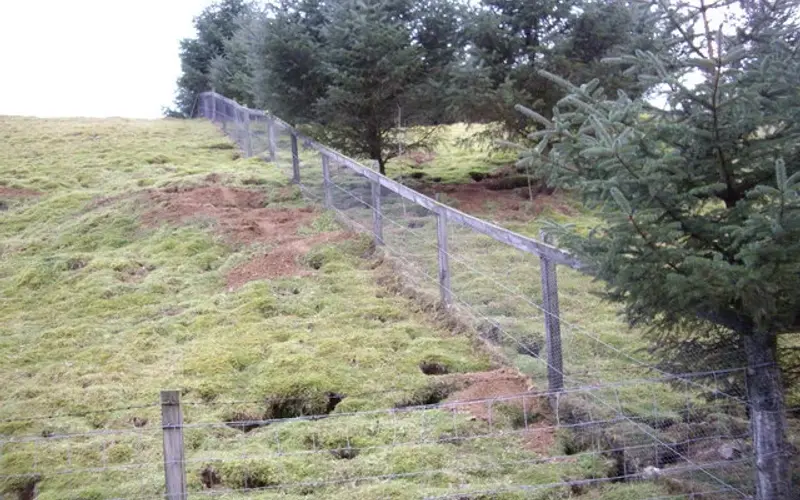
For high-value areas (orchards, vineyards, vegetable gardens, revegetation sites, and around homesteads), rabbit-proof fencing provides permanent protection. Effective rabbit fencing uses netting wire (40mm mesh) buried 150mm below ground with a 150mm apron turned outward to prevent digging under. While fencing doesn’t reduce the overall rabbit population, it protects specific areas from damage.
Our Integrated Pest Management Approach
The key to lasting rabbit control is doing things in the right order. Our IPM programmes follow a proven sequence:
- Property Assessment: We inspect your property to map rabbit warrens, feeding areas, and damage hotspots. Population density is estimated using PestSmart’s rabbit abundance scoring system: a 0 to 5 pellet density scale based on 15-minute search plots that maps to approximate adult rabbits per hectare. Concrete field indicators include crops eaten out within 50 metres of warrens and distinct browse lines at 50 centimetres above ground on shrubs. We identify soil types, terrain, and access constraints that affect method selection.
Important ecological note: rabbits are a major food source for foxes, feral cats, and other predators. Controlling rabbits without also controlling these predators can lead to increased predation on native animals, as predators switch prey. Consider the whole system when planning rabbit control and discuss concurrent fox management with your operator.
-
Program Design: Based on the assessment, we design a staged control programme. The standard sequence is: bait first (to reduce numbers), rip warrens second (to destroy breeding habitat), and shoot follow-up (to remove survivors). Timing is planned around soil conditions and the farming calendar.
-
Implementation: Our operators deliver the programme in stages. Baiting is typically conducted 2 to 4 weeks before warren ripping to reduce the population and make ripping more effective. Warren ripping is scheduled for dry periods when soil conditions are optimal. Follow-up shooting commences immediately after ripping to prevent survivors from establishing new harbour.
-
Monitoring: After the initial programme, we monitor the property for signs of rabbit recolonisation: fresh digging at ripped warrens, new warrens, grazing pressure returning. Trail cameras and spotlight counts provide quantitative data on population recovery.
-
Reporting: You receive a detailed report after each phase, including warrens ripped, estimated population reduction, methods used, and recommendations for maintenance. These reports support your property pest management records and can be used for LLS or NRM reporting.
Where We Operate
Our rabbit control services cover the key affected regions across NSW:
- Hunter Valley: river flats and farming country
- Northern Tablelands: grazing country with rocky harbour
- North West NSW: broadacre pastoral and cropping
- Central West NSW: mixed farming with significant rabbit populations
- North Coast NSW: cleared farming areas in the hinterland
We operate across properties of all sizes. For large-scale warren ripping operations, we coordinate earthmoving equipment and can work across multiple neighbouring properties to reduce mobilisation costs.
Pricing
Rabbit control programmes start from $500 per visit for baiting and shooting operations. Warren ripping and fumigation are quoted based on the number and distribution of warrens on your property, as ripping requires specialised earthmoving equipment. The most cost-effective approach is an integrated programme combining all methods. While the upfront investment is higher, it delivers lasting results.
Multi-property programmes reduce equipment mobilisation costs for warren ripping. Landholders may also be eligible for subsidised Pindone baits through Local Land Services (LLS) as part of NSW Government funded pest control programmes. We can help you access these subsidies where available. Contact us for a free property assessment and quote.
Get On Top of Your Rabbit Problem
Rabbits are easy to ignore until the damage is done, but every season you wait, the warrens expand, the pastures degrade, and the problem gets more expensive to fix. Our integrated approach targets the source of the problem, not just the symptoms.
Get a free property assessment today, call us or fill out our online form, and we’ll inspect your property, map the warrens, and design a control programme that delivers lasting results.