The Pigeon Problem in NSW
Feral pigeons (rock doves, Columba livia) are one of the most underestimated pest animals on Australian farms. While they don’t make headlines like feral pigs or wild dogs, the damage they cause to grain storage, infrastructure, and food safety is substantial and ongoing.
Originally domesticated from European rock doves, feral pigeons have thrived in rural Australia wherever grain is grown, stored, or fed to livestock. Grain silos, hay sheds, machinery bays, feedlots, and poultry facilities all attract pigeon colonies that can number in the hundreds or even thousands on a single property.
What damage do pigeons cause?
The costs of pigeon infestation are both direct and insidious:
- Grain contamination: Pigeons feed on stored grain, but more importantly, they contaminate it with droppings, feathers, and carcasses. A single pigeon produces approximately 11 to 12 kilograms of droppings per year. In a grain shed with 200 pigeons roosting overhead, that’s over two tonnes of droppings annually falling into your stored grain. Contaminated grain may be downgraded or rejected at receival, costing you money at delivery.
- Infrastructure corrosion: Pigeon droppings are highly acidic (pH 3.5 to 4.5) and corrode metal roofing, guttering, concrete, machinery, and painted surfaces. Over time, droppings accumulate on steel beams and roofing, accelerating rust and reducing the lifespan of sheds and infrastructure. The cost of repairing and repainting pigeon-damaged buildings adds up quickly.
- Disease transmission: Pigeons carry over 60 diseases and parasites, several of which pose genuine health risks to humans and livestock. Histoplasmosis (a serious fungal lung infection) grows in dried pigeon droppings and becomes airborne when disturbed. Salmonella contaminates grain and feed. Psittacosis and cryptococcosis are bacterial and fungal infections transmissible through dried droppings. Pigeon droppings also harbour bird mites, ticks, and lice that can infest workers and livestock.
- Biosecurity risk: For grain handlers, feedlots, and food storage operations, pigeon infestation is a biosecurity compliance issue. Contaminated grain and droppings in food storage areas can trigger regulatory action and damage your reputation with buyers and processors.
- Fouling and mess: Beyond the structural and health impacts, pigeon droppings foul walkways, vehicles, equipment, and livestock yards. The cleanup burden is constant and demoralising. You clean today, and it’s covered again tomorrow.
Why pigeons are so persistent
Feral pigeons are exceptionally well-adapted to the Australian farming environment. They breed year-round in Australia’s climate, producing 2 eggs per clutch with up to 6 clutches per year. Young birds reach breeding age at 5 to 6 months. Pigeons are also highly site-faithful. They return to the same roosting and nesting sites generation after generation. Remove the current colony without blocking access, and new birds will move in within weeks, drawn by the same food sources and shelter that attracted the original colony.
This persistence is why pigeon control requires more than just shooting. It requires a combination of population reduction and structural exclusion to break the cycle.
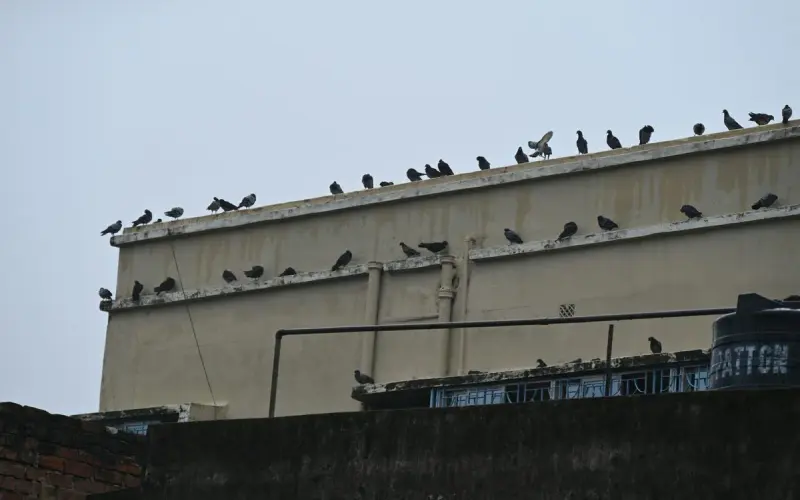
How We Control Pigeons
Shooting
Shooting is the most immediate method for reducing pigeon numbers on rural properties. We use PCP (pre-charged pneumatic) air rifles as our primary tool for pigeon control. PCP air rifles are ideal for this work because the power can be adjusted up or down based on the background and environment. Operating inside a grain shed with steel walls requires a different energy setting than shooting in an open yard. This adjustability makes PCP air rifles far safer around agricultural infrastructure than conventional firearms.
PCP air rifles are also quieter than shotguns or rimfire rifles, reducing disturbance to livestock and neighbours. With telescopic sights, they deliver precise shot placement on perched birds at ranges up to 25 metres, which covers the majority of pigeon control situations in and around farm buildings.
Only one bird is targeted at a time. Shooting at a flock is not acceptable under the national standard operating procedures (NATSOP BIR001). Wounded birds are located and dispatched immediately.
Shooting is most effective at dawn and dusk when pigeons move between roosting and feeding areas, and around grain handling operations when spilled grain attracts concentrated feeding. On large properties, shooting can be combined with thermal operations to target pigeons roosting in sheds and structures during darkness.
Shooting serves a dual purpose: direct population reduction and behavioural conditioning. PestSmart notes that shooting is more commonly used as a scaring strategy, training birds to associate the sharp, sudden noise with real danger. Killing small numbers enhances the scaring effect and can disperse pigeons from a site more effectively than noise alone. That said, shooting must be combined with exclusion measures for lasting results, as pigeons breed faster than shooting alone can reduce their numbers. All killed birds are collected and disposed of in accordance with local council requirements.
Trapping
Live-capture trapping is effective for removing established pigeon colonies, particularly in and around buildings where shooting is not safe or practical. We use:
- Bob traps: Walk-in cage traps that allow pigeons to enter but not exit. Placed near established feeding and roosting areas, baited with grain. Bob traps can capture multiple birds per day with minimal ongoing management.
- Funnel traps: Similar in principle to bob traps, using a funnel entry that pigeons walk through but cannot navigate in reverse.
Trapping is most effective when combined with pre-baiting, placing grain in and around the trap for several days before activating the trap mechanism, conditioning pigeons to feed at the trap location. Captured birds are dispatched humanely.
Exclusion Netting
Exclusion netting is the most effective long-term solution for protecting specific structures from pigeon infestation. We install UV-stabilised polyethylene netting (50mm mesh) across the openings and internal spaces of:
- Grain storage sheds and silos
- Machinery and equipment bays
- Hay sheds and feed stores
- Livestock housing and dairy facilities
- Loading bays and processing areas
Properly installed exclusion netting physically prevents pigeons from entering and roosting in protected structures. While the upfront cost is higher than shooting or trapping alone, netting is a permanent solution that eliminates ongoing pigeon damage, contamination, and cleanup costs in the netted area.
Netting installation requires careful attention to access points, ventilation, and operational requirements. We design each installation to work with your facility’s operations, not against them.
Deterrent Systems
Deterrent systems are secondary tools used to complement exclusion and population reduction:
- Spike strips: Stainless steel or polycarbonate spike strips prevent pigeons from landing on ledges, beams, sign tops, and equipment. Effective for specific perching points but impractical for large areas.
- Wire systems: Spring-tensioned wires along ledges and beams make landing surfaces unstable. Effective and less visually intrusive than spikes.
- Visual and sonic deterrents: Fake predator birds, reflective tape, and sonic devices provide short-term relief but pigeons habituate to them rapidly. We do not recommend these as standalone solutions.
Habitat and Hygiene Management
Reducing the food and shelter that attract pigeons is fundamental to long-term control:
- Grain management: Promptly clean up spilled grain around silos, augers, and handling equipment. Seal grain storage to prevent pigeon access. Cover open-top grain trailers and bins.
- Water management: Eliminate standing water sources near buildings: leaking troughs, puddles on shed floors, and blocked gutters all provide drinking water for pigeons.
- Roosting site management: Block access to internal ledges, beams, and cavities where pigeons nest. Remove old nesting material during cleanup operations.
Our Integrated Pest Management Approach
Pigeon control is most effective when multiple methods are applied in a logical sequence:
-
Site Assessment: We inspect your property to assess the pigeon population, identify roosting and nesting sites, map feeding areas, and evaluate damage. We examine grain storage facilities, sheds, and infrastructure to determine the best combination of control and exclusion measures.
-
Program Design: Based on the assessment, we design a control programme that addresses both the immediate pigeon population and the conditions that sustain it. This typically includes population reduction (shooting and/or trapping), exclusion netting on priority structures, and habitat management recommendations.
-
Implementation: Our operators deliver the programme in stages: population reduction first, followed by exclusion installation and hygiene measures. This sequence ensures that netting is installed once the colony has been reduced, preventing birds from being trapped inside structures.
-
Monitoring: After initial control, we monitor pigeon activity to assess whether the population is recovering, whether exclusion measures are intact, and whether new entry points have been exploited. Trail cameras and regular inspections provide data on population trends.
-
Reporting: You receive a detailed report after each visit, including estimated pigeon numbers, methods used, areas treated, exclusion measures installed, and recommendations for maintenance. These reports support your biosecurity records and food safety documentation.
Where We Operate
Our pigeon control services cover rural properties and grain facilities across NSW:
- Hunter Valley: vineyards, grain storage, and mixed farming
- Northern Tablelands: grain and livestock operations
- North West NSW: broadacre grain storage and feedlots
- Central West NSW: major grain growing and storage region
- North Coast NSW: rural properties and commercial facilities
We work with individual landholders, grain handling businesses, feedlot operators, and commercial facilities.
Pricing
Pigeon control starts from $500 per visit for shooting and trapping operations. Exclusion netting is quoted based on the area to be protected and the complexity of the installation. Ongoing management programmes with regular visits are available at reduced per-visit rates.
For grain storage facilities and commercial operations dealing with biosecurity requirements, we design comprehensive programmes covering control, exclusion, and hygiene management. Contact us for a free site assessment and quote.
Clean Up Your Pigeon Problem
Pigeons don’t just make a mess. They contaminate your grain, corrode your sheds, and create genuine health risks for you and your workers. Every day you wait, the colony grows and the damage accumulates. Our integrated approach combines immediate population reduction with permanent exclusion solutions.
Get a free site assessment today, call us or fill out our online form, and we’ll inspect your property, assess the damage, and design a pigeon control programme that delivers lasting results.