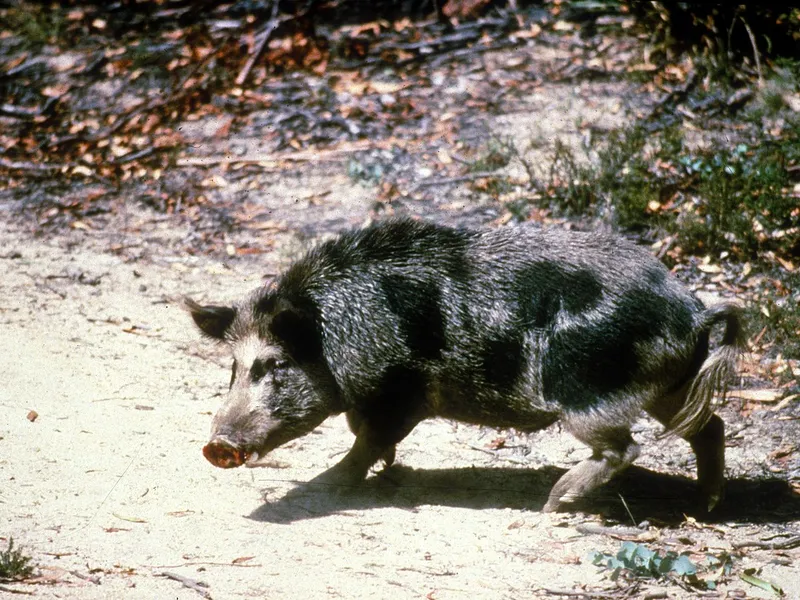
 Feral pig near Canberra. Photo: CSIRO, CC BY 3.0
The Vague Duty
You have a legal duty to control pest animals on your property. The Biosecurity Act 2015 says so. Your LLS office says so. The NSW Government website says so.
But when you ask the obvious question, “What exactly am I supposed to do?”, the answer you get is: take “reasonably practicable” steps.
What does that mean? How much do you have to spend? Which methods count? How do you prove it?
The government won’t say. The NSW DPI page on the General Biosecurity Duty states plainly: “There is no ‘one-size-fits-all’ approach.” The NSW Invasive Species Management Review in 2024, commissioned by the Natural Resources Commission, found “a lack of clarity about what is required.” The Invasive Species Council called the system “unstrategic, underfunded and uncoordinated.”
Meanwhile, the new Biosecurity Compliance and Investigation Unit started work in February 2026, and Minister Tara Moriarty’s message to landholders was direct: “if you breach biosecurity protocols and laws then there will be a price to pay.”
So you have a duty that is deliberately vague, enforcement that is tightening, and penalties that reach $1.1 million. This guide is the plain English version the government never published.
The Law in Plain English
Section 22 of the Biosecurity Act 2015 (NSW) creates the General Biosecurity Duty. In legal language:
Any person who deals with biosecurity matter or a carrier and who knows, or ought reasonably to know, the biosecurity risk posed or likely to be posed by the biosecurity matter, carrier or dealing has a biosecurity duty to ensure that, so far as is reasonably practicable, the biosecurity risk is prevented, eliminated or minimised.
In farmer language: if you know feral pigs are on your place (or should know, because there are pig diggings in your paddock), you must take reasonable action to deal with them.
Who It Applies To
The duty applies to everyone. Not just landholders. Not just farmers. Everyone who deals with a biosecurity risk and knows about it. That includes:
- Broadacre graziers and croppers
- Hobby farmers and lifestyle block owners
- Absentee landholders who don’t live on the property
- Government land managers (national parks, crown land, council reserves)
- Hunters who may move pest animals between properties
The NSW Government website for absentee landholders puts it simply: “Whether you do it yourself, or hire help, you’ve got to take action.”
The Five Factors of “Reasonably Practicable”
Section 16 of the Act defines “reasonably practicable” using five factors that must be weighed together:
- The biosecurity risk: What species are present and how serious is the threat?
- The degree of impact: How much damage could they cause to your operation, your neighbours, and the environment?
- Your knowledge: What do you know (or should you know) about the risk and the available control methods?
- Availability of control methods: What methods are accessible in your area? Are there LLS programs you can join?
- The cost: How much do control methods cost relative to the risk?
The fifth factor is critical. The Act explicitly states that it is not reasonably practicable if the cost is greatly disproportionate to the risk. You do not have to bankrupt yourself to comply. But you do have to show you did something proportional.
What Changed from the Old Laws
The Biosecurity Act 2015 came into effect on 1 July 2017, replacing all or part of 14 older Acts including the Rural Lands Protection Act 1998 and the Noxious Weeds Act 1993. The old system maintained species schedules listing “declared” pests. The new system replaced those schedules with a broad, flexible duty that covers all biosecurity risks.
The shift was deliberate. The old system was slow to update and could not keep up with emerging threats. The new system gives landholders flexibility to choose appropriate methods. But that flexibility is exactly what creates the confusion: there is no checklist you can tick off and know you are compliant.
What “Reasonable Steps” Actually Look Like
The government won’t define this. So here is a practical framework based on what LLS regional pest management plans actually recommend, what coordinated programs expect from participating landholders, and what would demonstrate compliance if an authorised officer assessed your property.
The Baseline: What Every Landholder Should Be Doing
1. Know what is on your property. You cannot manage what you do not know about. Walk your boundaries. Check for pig diggings, deer tracks, fox dens, and rabbit warrens. Use trail cameras at creek crossings, fence gaps, and known travel corridors. Report sightings to FeralScan (free, builds your compliance record).
2. Participate in coordinated programs. Contact your Local Land Services office and join their regional pest control programs. These include coordinated 1080 and PAPP baiting, aerial shooting programs, and trap loan schemes. LLS coordinates across 11 regions and works with 9,369 landholders across 18 million hectares. Participation in coordinated programs is strong evidence of compliance.
3. Use a combination of control methods. No single method works alone. Best practice is integrated pest management: monitoring to understand the problem, baiting and trapping to reduce numbers, shooting to remove survivors, and fencing to protect high-value areas. A landholder who only shoots a pig occasionally when they see one has a weaker compliance position than a landholder who participates in baiting programs, sets traps, and monitors with cameras.
4. Coordinate with your neighbours. Pests do not respect property boundaries. The Act’s shared responsibility model means coordination is expected. Talk to your neighbours about timing baiting programs together. Join or form a local pest management group. If neighbouring properties are not managed (hobby farms, absentee owners), document your attempts to coordinate and report the situation to LLS.
5. Keep records. This is the single most important thing you can do for compliance. Records prove you took action. Without records, you have nothing but your word. See the record-keeping section below for specifics.
Scaling for Property Size and Type
What counts as “reasonable” varies by operation:
Large grazing and cropping properties (500+ hectares): Participation in coordinated LLS programs. Active baiting and/or trapping programs at least seasonally. Monitoring (trail cameras or regular observation). Engagement with neighbours and local pest management groups. Professional pest control for species or situations beyond your capacity.
Mid-size mixed farms (50 to 500 hectares): Participation in coordinated programs when available. At least seasonal control effort (baiting, shooting, or trapping) aligned with the annual pest control calendar. Monitoring and recording pest activity. Coordination with neighbours.
Small acreage and hobby farms (under 50 hectares): Awareness of pest species present. Reporting to FeralScan. Participation in any available coordinated programs. Ensuring your property is not a harbour for pests that affect neighbours.
That last point matters. Neville Mattick, a multi-generational farmer at Hargraves whose lambing rate collapsed from 118% to less than 1% because of feral pigs, described the impact of non-participating neighbours: “They are nice people from the city, but they come up and they ride a buggy around their property. They might shoot a goat, but they don’t want anything to do with cohesive land management.”
Absentee landholders: The same duty applies whether you live on the property or not. Engage a local contact or professional service to manage pests in your absence, or a monitoring service that keeps eyes on the block and produces the records for you: our Absentee-Owner Monitoring retainer is built for exactly this. Participate in coordinated programs through your LLS office even if you are not physically present. For the full picture, including how to discharge the duty and build the record when you are hours away, see our guide to absentee and lifestyle landowner pest control.
The Penalties: What Non-Compliance Actually Costs
The penalty structure under the Biosecurity Act 2015 is substantial, even though it has rarely been applied to pest animal control.
Penalty Table
| Offence Category | Individual Maximum | Corporation Maximum | Daily Continuing Penalty |
|---|---|---|---|
| Category 2 (standard breach) | $220,000 | $440,000 | $55,000 / $110,000 |
| Category 2 (committed negligently) | $1,100,000 | $2,200,000 | $137,500 / $275,000 |
| Category 1 (intentional/reckless with significant impact) | Fine + up to 3 years imprisonment | $2,200,000 | Determined by court |
Company directors and officers can be personally liable under the executive liability provisions. If your farm operates through a company or family trust with a corporate trustee, the directors are personally exposed to these penalties alongside the entity.
The Enforcement Escalation
Enforcement follows a graduated process. Authorised officers do not jump straight to prosecution:
Step 1: Education and guidance. LLS officers, biosecurity officers, and local council staff provide advice on how to discharge your duty. Most landholders never go beyond this step.
Step 2: Compliance request. A formal request to take specific action. Not legally binding, but signals that your current effort has been assessed as insufficient. This is the yellow flag.
Step 3: Biosecurity direction. A legally binding direction from an authorised officer requiring you to take specific actions within a specified timeframe. Failure to comply is an offence.
Step 4: Penalty infringement notice. Issued when a biosecurity direction is not complied with. You can pay the penalty or contest it in court.
Step 5: Court prosecution. For serious or persistent breaches. The $220,000 to $2.2 million penalties apply at this stage.
The Reality So Far
Enforcement for pest animal control has been minimal. The 2024 NSW Invasive Species Management Review found that “compliance and enforcement provisions in the Biosecurity Act 2015 have not been well-defined or resourced” and that “poor enforcement is undermining the legitimacy of the system.”
No NSW farmer has been publicly prosecuted for failing to control pest animals. The record biosecurity fine ($45,000 against Argyle Foods Pastoral) was for livestock traceability breaches, not pest management.
But the direction is clear. The new Compliance Unit has six dedicated staff and a mandate to expand enforcement. The Biosecurity Commissioner’s technical review of feral pig and deer management is due in October 2026. NSW Farmers President Xavier Martin has called for stronger enforcement, saying “a slap on the wrist for breaches and a spotfire approach will do little to protect our industry.”
In July 2026 the escalation path above stopped being theoretical. The NSW Government announced its first General Biosecurity Direction for feral pig control, covering every public and private landholder in the Walgett region in the state’s north west and requiring them to take part in a coordinated control programme combining baiting, trapping, and aerial and ground shooting. Penalties run to $220,000 for individuals and $440,000 for corporations, including government agencies, and can continue to apply each day until a landholder complies. The pilot is scheduled to start in November 2026 and run through to 30 June 2027, and the government has said it could be extended to other parts of NSW, including areas dealing with both pigs and deer, if it works. It is the first time the Biosecurity Act 2015 has been used this way for feral pigs or deer.
Be careful about what that does and does not mean. It covers one region. It had not started at the time of writing. No NSW landholder has been prosecuted for failing to control feral animals, and we are not going to tell you a fine is heading your way. If your country is outside the Walgett region, nothing about your legal position changed in July.
What it does mean is that Step 3 of the escalation above can now be shown compelling feral animal control across every tenure in a district, rather than described as a possibility. The pushback from the farming sector is on the record as well. NSW Farmers president Rebecca Reardon said the organisation was “horrified that the government seems more interested in using the big stick with a compliance and fines approach rather than working with farmers”, and Walgett agronomist Peter Meppem, who supports coordinated control, told The Land that “while we need a coordinated approach from everyone, facing fines for failing to comply with the eradication program is a step too far, especially for smaller landholders.”
The practical risk is not a $1 million fine tomorrow. The practical risk is that enforcement is building while your compliance evidence is not.
Species-Specific Obligations
Not all pest animals carry the same legal weight in NSW.
Wild Dogs: The Strongest Obligation
Wild dogs (including dingoes and hybrids) are the only common pest animal with a double legal obligation. They are declared pests under the Local Land Services Act 2013, which specifically requires occupiers to “take all practical measures to minimise the risk of negative impacts.” They also fall under the General Biosecurity Duty.
This means wild dogs carry the most enforceable obligation of any pest species. If wild dogs are operating on your property and you are doing nothing, your legal exposure is higher than for any other species. See our wild dog control guide for what NSW programs are available.
Feral Pigs: The Priority Pest
Feral pigs fall under the General Biosecurity Duty, with additional prohibitions on certain dealings (keeping, moving, or releasing pigs) under Section 17B of the Biosecurity Regulation 2017. They are the primary focus of the $14.3 million Feral Pig and Pest Program 2025-26 and the Biosecurity Commissioner’s current review.
LLS removed 83,207 feral pigs through direct control in 2024-25, with an estimated 196,000 additional pigs controlled through 1080 bait programs. The scale of government investment signals that pig control is a top priority, and landholders who do not participate in available programs have a weaker compliance position. See our feral pig control guide for methods.
Foxes and Rabbits: Under the Radar
Foxes and rabbits both fall under the General Biosecurity Duty with Section 17B dealing prohibitions. Rabbits also have specific provisions under Section 17A of the Regulation. In practice, fox and rabbit enforcement is even lighter than for pigs and dogs, but the legal duty is the same.
Both species are routinely targeted in LLS coordinated programs, particularly autumn and spring 1080 baiting campaigns. Participation in these programs demonstrates compliance for both species simultaneously.
Feral Deer: The Anomaly
Feral deer fall under the General Biosecurity Duty, but the NSW Government’s own website contains a remarkable statement: farmers “are not subject to penalties for not taking action” on deer. This creates a practical gap where deer cause significant damage but the enforcement mechanism is weaker than for other species.
This may change. The Biosecurity Commissioner’s review specifically covers feral deer management, with recommendations due October 2026. NSW Farmers has called for feral deer to be declared pests under a formal biosecurity control order. For now, the practical advice is to control deer where they cause damage (you no longer need a game hunting licence on private land) and document your efforts. See our feral deer guide for species identification and control methods.
Proving You Are Compliant: What Records to Keep
Records are your best defence. If an authorised officer asks what you have done to discharge your biosecurity duty, the answer should be a folder (physical or digital) with documented evidence, not a vague “we shoot them when we see them.”
What to Record
Pest control activity log: Date, method used, species targeted, location on property, outcome (numbers removed, bait taken, trap checks). A simple spreadsheet or diary is fine.
Program participation: Dates you participated in LLS coordinated baiting, aerial shooting, or trapping programs. Keep any correspondence or confirmation from LLS.
Monitoring data: Trail camera records, FeralScan submissions, damage observations. Trail cameras with AI analysis create particularly strong evidence of both the problem and the control outcome. See our guide on trail cameras and AI for pest monitoring.
Financial records: Receipts for ammunition, bait, traps, fencing, professional pest control services, fuel for pest control operations. These records also support your tax deductions.
Neighbour coordination: Records of discussions with neighbours about coordinated control. Notes from local pest management group meetings.
Professional reports: If you engage a professional pest control service, keep their assessment reports, activity reports, and data on outcomes. Professional documentation carries weight because it is produced by a licensed operator with no personal interest in overstating your compliance.
Legally Compulsory Records
Pesticide use records are compulsory under Part 4 of the Pesticides Regulation 2017 for anyone using pesticides for commercial or occupational purposes. This includes 1080 baiting. Records must include date, location, product used, application rate, and target pest.
Livestock traceability records (NLIS) must be updated within 2 days of stock movements. Annual land and stock returns are due by 31 August each year.
Free Tools
FeralScan (feralscan.org.au): Free app used by 40,000+ Australians to record pest sightings, damage, and control activities. Creates a timestamped, GPS-tagged record of your pest management activity. The closest thing to a digital compliance diary.
Not sure where you stand? Contact Feral Up for a free property assessment. We review your current pest pressure, identify gaps in your control program, and provide a documented report you can keep on file.
The Neighbour Problem
The most common frustration from NSW farmers is not the pest animals themselves. It is neighbours who will not manage them.
Graeme Christopherson at Lower Lewis Ponds put it directly: “All the surrounding areas have been bought by recreational hunters or people you know that come up from Sydney, which is fine, they’re good people, but they’re not running any stock.” His lambing rate collapsed to 47 lambs from over 600 ewes in two years because wild dogs breed unchecked on neighbouring properties.
Renard Saunders at Tinderry described his situation: “Every good bit of ground gets trashed, and they’re all coming from one place, the State Conservation Area.”
What You Can Actually Do
1. Contact LLS (1300 795 299). LLS coordinates regional pest management and can engage reluctant neighbours through coordinated programs. Some landholders participate more willingly when approached by a government officer than by a frustrated neighbour.
2. Document the cross-boundary impact. Trail cameras at boundary fence lines, FeralScan reports, and damage records build the evidence that pest pressure is coming from a specific direction.
3. Request a biosecurity direction. If a neighbour is genuinely refusing to manage pests and the impact on your property is significant, LLS or your local council can escalate through compliance requests and ultimately issue a biosecurity direction, which is legally binding.
4. Join or form a Feral Fighters group. LLS supports local pest management groups that coordinate control across multiple properties. Group programs are more effective and often attract government funding and free bait.
5. Protect your own boundaries. Where coordination fails, physical measures like exclusion fencing and intensive boundary control (baiting, trapping, and shooting along your boundary) reduce the impact of unmanaged neighbouring properties.
Insurance and Tax Connections
Insurance
Standard farm insurance does not cover most feral animal damage directly. But your biosecurity compliance affects your position if a claim is ever disputed. Most policies contain a “reasonable precautions” clause. A documented pest management program makes it difficult for an insurer to argue you failed to take precautions. A documented failure to comply with a biosecurity direction would weaken your claim. See our full guide: Does Your Farm Insurance Cover Feral Animal Damage?
Tax Deductions
Every dollar you spend on pest control is tax deductible for primary producers. Routine expenses (baiting, ammunition, trapping, professional services) are immediately deductible as business expenses. Capital expenditure on exclusion fencing qualifies as a landcare operation under Section 40-630 of the ITAA 1997, deductible in full in the same income year. This means your biosecurity duty compliance generates a guaranteed tax benefit.
Government Programs That Help
You are not expected to fight this alone. LLS operates significant programs across all 11 regions:
- Coordinated 1080 baiting: Free bait, free grain (196,490 kg distributed in 2024-25), authorised officers deploy and manage the program
- Aerial shooting programs: 41 programs conducted in 2024-25
- Trap loan schemes: Cage traps and soft-jaw traps available for loan
- Feral Fighters groups: Local coordinated control with LLS support and funding
- VPIT training: Free training to use vertebrate pesticides (1080, PAPP)
- Trail cameras and equipment loans: Available in some regions
- 38,582 one-on-one pest management consultations delivered in 2024-25
Contact your local LLS office or call 1300 795 299 to find out what is available in your area.
Need help meeting your biosecurity duty? Contact Feral Up for a free phone consultation. We provide property assessments, monitoring, and control programs that create documented compliance evidence, including an Annual Stewardship and Compliance Program that does the control and hands you an annual report built for your records. Professional pest management reports strengthen your biosecurity position while reducing pest numbers on your property.