The Short Answer
You spend $20,000 a year fighting feral pigs. They destroy $50,000 worth of crops anyway. You call your insurer. They point to the vermin exclusion clause. No payout.
This is not a gap in your particular policy. It is how every major rural insurer in Australia writes their farm coverage. The vermin and pest exclusion appears in policies from WFI, CGU, QBE, NRMA, Suncorp, and Elders. It excludes direct damage from feral pigs, deer, rabbits, foxes, wild dogs, and every other pest animal.
There are exceptions worth knowing about. And there are financial tools that actually work. This guide covers both.
What Standard Farm Insurance Does Not Cover
Crop Damage
WFI’s Early Bird Crop Policy, the most widely held crop insurance in rural NSW, states it clearly. The policy excludes “loss or damage directly or indirectly caused by livestock, birds, pests, vermin, insects, larvae, or disease, howsoever caused.”
That last phrase matters. “Howsoever caused” means the exclusion applies regardless of the circumstances. Whether feral pigs destroy 40 acres of freshly sown pasture in one night or gradually eat their way through a barley crop over a season, the exclusion applies.
Standard named-peril crop policies (fire, hail, and sometimes frost) do not cover pest damage of any kind. For context on the scale of crop damage feral pigs cause, see our guide on how to control feral pigs on your property.
Pasture and Soil Destruction
Feral pig rooting creates craters up to half a metre deep across entire paddocks. Lyndon Barry near Braidwood repastured 60 acres. Feral pigs took 40 of those acres within the first month. “Pasturing is very expensive these days,” he told The Land, “and all your preparation and all your work that goes into it.” His neighbour loses approximately 100 acres of pasture annually, requiring constant harrowing and reseeding.
None of this is insurable under standard farm policies. Insurance covers sudden, accidental events. Recurring pest damage to pasture is classified as gradual damage and excluded.
Fence Damage
Farm insurance covers fencing and gates as insured property. But the pest exclusion applies here too. CGU’s Countrypak policy excludes “damage caused directly by the gnawing, biting, chewing, clawing, scratching, polluting or contaminating by animals.”
Feral deer pushing through fences, pigs digging under them, or kangaroos colliding with them: all excluded under this wording. Properties with heavy deer pressure report spending $5,000 to $15,000 per year on fence repairs that insurance will not cover. Our guide on feral deer species and impact in NSW covers the damage each species causes.
The Size of the Gap
The numbers are confronting. ABARES estimated in 2023 that established pest animals and weeds together cost Australian agriculture $5.3 billion per year in combined control costs and production losses. That figure bundles weeds in with pest animals, which is why it sits so far above the roughly $1 billion a year attributed to established vertebrate pests on their own; both are ABARES numbers measuring different things, and our reference page on what feral animals cost Australian agriculture sets out the species-level breakdown. The average NSW farmer spends $21,950 per year on pest and weed control, a figure that has nearly doubled since 2019.
Almost none of this is recoverable through insurance.
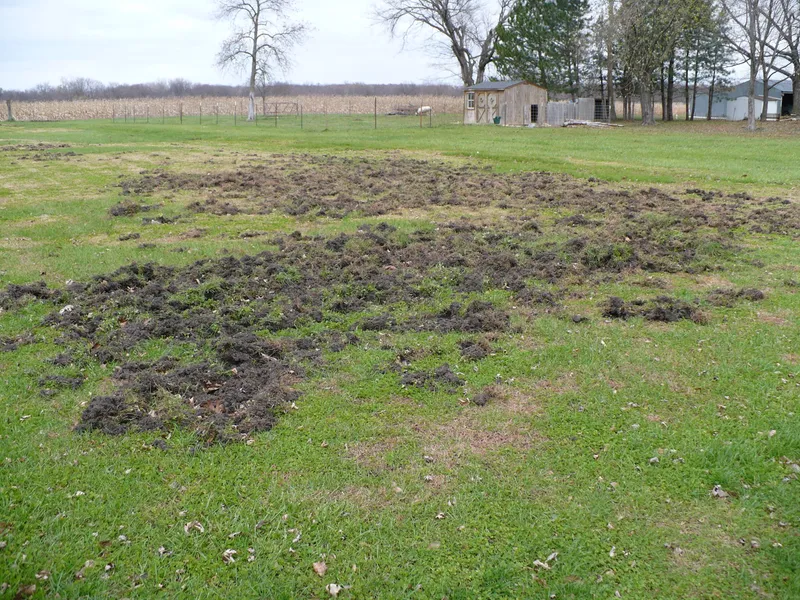 Feral swine can destroy pasture in a single night. Photo: U.S. Department of Agriculture, CC BY 2.0, via Wikimedia Commons.
What IS Covered
The exclusions are broad, but there are exceptions that every farmer should understand.
Vehicle Collisions with Feral Animals
This is the clearest area of coverage. Comprehensive motor insurance covers vehicle damage from hitting any animal, whether a kangaroo, feral deer, wombat, or fox.
NRMA reported more than 15,000 animal collision claims in 2025, a 21 percent increase on the previous year. NSW accounted for 30 percent of all national animal collision claims, the highest of any state. Hotspots include Dubbo, Goulburn, and Yass.
Key facts about animal collision claims:
- Average claim cost: $5,500 to $6,400
- 14 percent of claims result in the vehicle being written off
- Claims are generally treated as not at-fault, so your premiums should not increase
- Peak season: April to September (shorter daylight hours)
- Kangaroos account for 84 percent of claims, with deer, wallabies, and wombats making up the rest
In Tasmania, deer-specific collision claims rose 160 percent over five years and claim costs rose 330 percent, reaching nearly $800,000 from RACT data alone. As NSW deer populations grow, expect similar trends here.
The motor section of your farm pack policy may also cover vehicle damage from feral animals, even when the property sections exclude pest damage. Check your specific policy wording.
Third-party property insurance does not cover damage to your own vehicle. You need comprehensive cover for animal collision protection.
Consequential Damage from Pest Activity
Here is an important distinction. If feral animals cause secondary damage through a covered peril, that secondary damage may be covered.
Say mice chew through electrical wiring in your machinery shed. The chewed wiring causes a fire. The fire damage to the shed and its contents is covered under the fire peril. The damage to the wiring itself is not (that is direct pest damage).
IAG confirmed this principle publicly during the 2021 mouse plague. If a covered peril results from pest activity (fire from chewed wiring, water damage from chewed pipes), the resulting damage is insurable. The direct pest damage is not.
Livestock Mortality Insurance
Livestock mortality policies from WFI, CGU, QBE, and other rural insurers can cover death from “attacks by dogs or wild animals.” Some policies also cover livestock “stressed by dogs, foxes, or vermin to the point of death.”
There is a significant limitation. Livestock mortality insurance is designed for individual high-value breeding stock: stud bulls, rams, stallions, and breeding cows. Coverage is based on declared value per animal.
Commercial flock and herd coverage against predation is either unavailable or prohibitively expensive at scale. The practical reality is that most sheep and cattle producers self-insure for predation losses. When Graeme Christopherson at Lower Lewis Ponds lost hundreds of thousands of dollars worth of stock to wild dogs, there was no insurance payout. “And there’s no compensation for any lost stock,” he told The Land.
If you run high-value stud stock in areas with wild dog or fox pressure, ask your broker specifically about predator attack coverage. It is available and may be worth the premium for animals valued at thousands of dollars each.
Multi-Peril Crop Insurance
Multi-peril crop insurance (MPCI) is the one product that may cover crop damage from feral animals. MPCI from specialist underwriters like Primacy (backed by Allianz) and Latevo (backed by Assetinsure) can cover pest-related yield loss as a named peril.
The catch: MPCI requires at least five years of production history, premiums are substantially higher than standard crop insurance, and the product compensates for yield loss against a guaranteed production level rather than covering the full crop value. Latevo charges a $5,500 risk assessment fee before you even get a quote.
Uptake among Australian farmers is very low. But for properties with severe, recurring feral pig crop damage running into tens of thousands of dollars per season, MPCI may be worth investigating. Talk to a specialist broker like Primacy, Dunk Insurance, or Regional Insurance about whether the numbers work for your situation.
No Government Safety Net Either
If insurance does not cover the damage, does the government compensate farmers?
No. NSW has no compensation scheme for livestock losses to wild dogs, foxes, feral pigs, or any other feral predator. There is no livestock indemnity program. Pest animal outbreaks are not classified as natural disasters under the NSW framework, so they do not trigger disaster relief grants or concessional loans.
What the Government Does Provide
The NSW Government does invest in prevention and control through Local Land Services:
- $14.3 million for the Feral Pig and Pest Program 2025-26
- $850,000 in free grain and 1080 bait for landholders
- Free VPIT training (required to use 1080; see our guide to 1080 and PAPP baits)
- Equipment loans for traps and trail cameras
- Biosecurity officer consultations via 1300 795 299
- $3.2 million in drought-related pest management funding (2025-26)
These programs are valuable and underused. Many farmers do not realise they can access free bait, free training, and borrowed equipment by calling their local LLS office. Our complete guide to pest control funding for NSW farmers covers every available program in detail, including grants, loans, and tax deductions. But these programs help you control animals. They do not reimburse you for damage already done.
How Australia Compares to the US
The contrast is stark. In the United States, the Federal Crop Insurance Program explicitly covers wildlife damage to crops. The USDA actively manages feral swine through a funded national program. The Farm Service Agency’s Livestock Indemnity Program pays 75 percent of fair market value for livestock killed by federally reintroduced or protected animals. Wyoming pays seven times market value for livestock killed by wolves, because many carcasses are never found.
In Australia, farmers bear the full cost. Government spending on pest control totals roughly $24 million per year across state and federal programs. Farmers spend $3.8 billion. That makes the government contribution less than one percent of what farmers spend themselves.
Your Biosecurity Duty and Your Insurance
Under the Biosecurity Act 2015, every landholder in NSW has a General Biosecurity Duty to prevent, eliminate, or minimise biosecurity risks “so far as is reasonably practicable.” Feral animals are biosecurity matter. This means you are legally required to manage them on your land.
Maximum penalties for failing this duty reach $1.1 million for individuals and $2.2 million for corporations. In February 2026, the NSW Government established a dedicated Biosecurity Compliance and Investigation Unit with six full-time enforcement staff. Minister Moriarty stated: “if you breach biosecurity protocols and laws then there will be a price to pay.”
How This Connects to Insurance
Most farm insurance policies contain a “reasonable precautions” condition requiring you to take reasonable steps to prevent or minimise loss. If you have a claim disputed, a documented record of pest management strengthens your position.
The legal test here is important. Australian courts have held that reasonable precautions clauses are only triggered by recklessness, not negligence. An insurer cannot deny your claim simply because you did not follow every regulation perfectly. They must prove you had actual knowledge of a specific danger and deliberately disregarded it.
In practice, a farmer with any documented pest management effort (even basic, imperfect effort) makes it extremely difficult for an insurer to argue recklessness. A farmer who knows wild dogs are attacking their stock, has been advised to bait, and does nothing at all is in a weaker position.
A documented pest management plan protects you on two fronts: it demonstrates you are meeting your biosecurity duty (important with the new compliance unit), and it strengthens your insurance position if a claim is ever challenged.
Tax Deductions: The Financial Tool That Actually Works
Since insurance will not cover the damage and the government will not reimburse you, tax deductions are the most valuable financial mechanism available to NSW farmers for pest control. Our complete guide to tax deductions for feral animal control covers every deduction pathway in detail. Here is the summary.
Immediate Deductions for Routine Pest Control
All routine pest control costs are deductible as ordinary business expenses in the year you incur them:
- Professional pest control services (contract shooting, baiting programs)
- 1080 and PAPP baits
- Ammunition used for pest control
- Trap purchase and maintenance
- Trail cameras and monitoring equipment
- Fuel and vehicle costs for control operations
Landcare Operations Deduction for Capital Works
Capital expenditure on pest management infrastructure qualifies as a landcare operation under the Income Tax Assessment Act 1997. Primary producers can claim the full cost as an immediate deduction.
This covers:
- Exclusion fencing: A $16,000/km deer fence or pig exclusion fence is immediately deductible
- Trap infrastructure: Permanent trap installations and yards
- Water point modifications: Alterations to exclude feral animals from stock water
The ATO specifically recognises “eradicating or exterminating animal pests from the land” as a qualifying landcare activity.
What Records to Keep
For tax purposes, maintain:
- Invoices and receipts for all pest control expenses
- A log of dates, locations, and methods used for control activities
- Fuel logs for pest control operations
- Records of any pest control equipment purchased
- Photographs of damage (supporting the business purpose of the expense)
Your accountant can advise on the specific classification of each expense, but the general principle is clear: pest control spending by primary producers is immediately deductible.
How to Document Feral Animal Damage
Good documentation serves three purposes: supporting insurance claims (where coverage exists), demonstrating biosecurity compliance, and substantiating tax deductions. One set of records covers all three.
What to Record
After every incident:
- Date, time, and GPS location
- Species involved
- Number of livestock killed or injured
- Extent of crop, pasture, or infrastructure damage
- Photographs from multiple angles
Ongoing monitoring:
- Trail camera images (date-stamped)
- FeralScan app sighting reports (free, creates official record)
- Regular property inspection notes
Control actions:
- Baiting dates, locations, quantities, and bait type
- Trap deployment records
- Shooting records (dates, species, numbers)
- Coordination with LLS programs
- Professional pest control visit reports
Financial records:
- Stock valuations and breeding records
- NLIS tag data
- Purchase and sale receipts
- Crop input costs for damaged areas
The FeralScan App
FeralScan (feralscan.org.au) is a free app that lets you record pest animal sightings, damage, and control actions. Your records feed into the national database, which supports regional control programs. It also creates a timestamped record of your pest management activity, useful for both biosecurity compliance and insurance documentation. Trail cameras with AI identification can supplement your monitoring and provide timestamped photographic evidence of pest species on your property.
Questions to Ask Your Insurance Broker
If you have not reviewed your farm insurance in the context of feral animal pressure, here are the specific questions to raise at your next renewal:
-
Does my policy’s vermin/pest exclusion apply to feral deer, pigs, and wild dogs specifically? (Some policies, like Suncorp’s, distinguish between “vermin” and “wild animals.” This distinction could matter.)
-
Does my livestock mortality section cover predator attacks? If you run high-value stud stock, confirm that death from wild dog, fox, or feral pig attack is a covered event.
-
Does the motor section of my farm pack exclude animal damage? The motor section may have different exclusions than the property sections.
-
Would multi-peril crop insurance make sense for my operation? If you are losing more than $20,000 per year to feral pig crop damage, MPCI may be worth the premium.
-
Does my policy have a reasonable precautions clause, and what does it require? Understanding this clause helps you know what documentation to maintain.
-
Can you show me exactly where the pest/vermin exclusion appears in my PDS? Read it yourself. The wording matters, and policies differ.
Want to reduce feral animal damage on your property? Get a free phone consultation and we will assess your pest situation and recommend the most effective control approach for your land. Professional pest management protects your livestock, your crops, and your compliance position, and every dollar you spend is tax deductible. Call us on 0493 417 929.