Why Two Toxins?
1080 baiting is the backbone of feral animal control across NSW. But it is not the only option. Australia uses two main toxins for vertebrate pest baiting: 1080 (sodium fluoroacetate) and PAPP (para-aminopropiophenone). Both are restricted Schedule 7 substances. Both require training and certification before you can handle them. And both serve different purposes depending on the target species, the landscape, and how close you are to working dogs.
Understanding the difference matters because the right choice depends on your situation. 1080 remains the workhorse for large-scale and aerial programmes. PAPP fills the gap where working dog safety is a priority or where 1080 use is restricted. Neither is perfect on its own, and neither replaces the need for integrated pest management.
This guide covers how each toxin works, what products are available, the legal requirements in NSW, how to participate in coordinated programmes, and what to do when baiting alone is not enough.
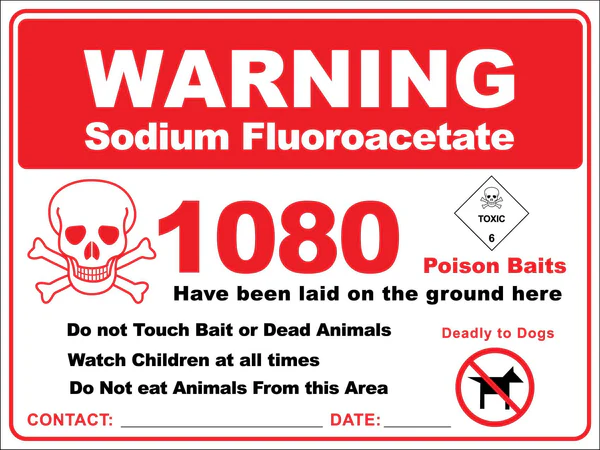
How 1080 Works
1080 is a metabolic poison. Its chemical name is sodium fluoroacetate.
Once an animal swallows a 1080 bait, the fluoroacetate enters the citric acid cycle (the process cells use to produce energy) and converts to a compound called fluorocitrate. Fluorocitrate blocks a key enzyme called aconitase, which shuts down the entire energy production cycle. Without cellular energy, the heart and nervous system fail.
The process takes time. First symptoms typically appear around three hours after ingestion, and death occurs 2 to 10 hours later depending on the species and dose. For larger mammals, it can take longer.
Why Australia uses 1080: Around 40 native plant species in south-western Western Australia naturally produce fluoroacetate as a defence against herbivores. Animals in those regions, including brushtail possums, western grey kangaroos, and bush rats, have evolved significant tolerance. WA brushtail possums can survive 150 times the dose that would be lethal to their eastern cousins. Introduced species like foxes, wild dogs, rabbits, and feral pigs have no evolutionary exposure and are highly susceptible.
Environmental breakdown: 1080 does not persist in the environment the way some pesticides do. Soil bacteria (primarily Pseudomonas species) and fungi (Fusarium oxysporum) break it down into non-toxic glycolic acid through a process called defluorination. Soil half-life is 6 to 8 days at 20 degrees Celsius. In water, 1080 degrades within one to two weeks. In practical terms, your land and water are not permanently contaminated by a baiting programme.
The critical limitation: There is no antidote. For any species, including humans. If a working dog eats a 1080 bait, the prognosis is extremely poor unless vomiting can be induced within minutes of ingestion. This is the single biggest concern for farmers who rely on dogs.
How PAPP Works
PAPP takes a completely different approach. Instead of shutting down energy production, PAPP converts normal haemoglobin in red blood cells into methaemoglobin. Methaemoglobin cannot carry oxygen. As the conversion progresses, the animal’s heart and brain are starved of oxygen.
The effect is faster than 1080. First symptoms appear within about 30 minutes. Animals become tired, lose coordination, lie down, lose consciousness, and die within 1 to 2 hours. The process resembles falling asleep under anaesthesia rather than the violent seizures associated with 1080 poisoning.
PAPP was registered by the APVMA in January 2016 after 12 years of research and development. It was the first new predator toxin approved in Australia in over 50 years.
The antidote advantage: Methylene blue reverses the effects of PAPP by converting methaemoglobin back to functional haemoglobin. A veterinarian must administer it intravenously, ideally within 30 to 60 minutes of ingestion. This is a genuine advantage over 1080, but it comes with a practical reality that every farmer in remote NSW understands: getting a dog to a vet within 30 minutes is not always possible. Research into a farmer-usable antidote formulation is ongoing.
Limitations: PAPP costs roughly double the price of 1080. It is not approved for aerial application because of sensitivity in goannas during warmer months. And it is not a replacement for 1080. As the National Wild Dog Action Plan coordinator put it: “It certainly wouldn’t replace 1080. It’s just another tool.”
Environmental profile: PAPP breaks down in soil through microbial action and poses minimal water contamination risk. Secondary poisoning risk is very low because a scavenging animal would need to consume material directly from a poisoned animal’s stomach before the toxin degrades.
Comparing 1080 and PAPP
Here is how they compare on the factors that matter most to landholders.
| Factor | 1080 (Sodium Fluoroacetate) | PAPP (Para-aminopropiophenone) |
|---|---|---|
| How it works | Blocks cellular energy production (Krebs cycle) | Prevents oxygen transport in blood |
| Time to first symptoms | About 3 hours | About 30 minutes |
| Time to death | 2 to 10 hours | 1 to 2 hours |
| What it looks like | Seizures, frenzied running, vomiting, convulsions | Drowsiness, loss of coordination, unconsciousness |
| Antidote | None | Methylene blue (IV, by vet, within 30 to 60 minutes) |
| Cost | Standard | Roughly double |
| Aerial use | Approved | Not approved |
| Bait marker | Red beads | Yellow/orange beads |
| Sign of poisoning in carcass | No specific marker | Grey-blue gums and tongue |
| Soil persistence | Half-life 6 to 8 days at 20C | Broken down by microorganisms, low persistence |
| Secondary poisoning risk | Present (carcasses toxic up to 75 days in cool conditions) | Very low |
| Best suited for | Large-scale, remote, and aerial programmes | Peri-urban areas, where working dog safety is critical |
When to choose 1080: Large properties with rugged or inaccessible terrain where aerial baiting is the only practical option. Coordinated landscape-scale programmes through LLS. Situations where cost is a factor and working dogs can be secured away from baited areas.
When to choose PAPP: Properties with working dogs that cannot be reliably separated from baited areas. Peri-urban or semi-rural locations where 1080 restrictions apply. Situations where the antidote advantage provides meaningful insurance, particularly if a veterinary clinic is within 30 minutes’ drive.
What Products Are Available?
The branded vertebrate pesticide products below are manufactured by Animal Control Technologies Australia (ACTA) and registered through the APVMA. Standard 1080 meat baits are prepared by authorised operators from raw 1080 solution supplied separately.
For Wild Dogs
- 1080 meat baits: Fresh or dried meat baits injected with 1080 solution. Used for both aerial and ground baiting. The standard for large-scale coordinated programmes.
- DOGABAIT: PAPP at 1000 mg per 60 g bait. Ground use only. Contains yellow/orange marker beads for identification in poisoned animals.
For Foxes
- 1080 meat/wing baits: Chicken wing-type baits or manufactured meat baits with 1080. Used in ground baiting programmes.
- FOXECUTE: PAPP at 400 mg per 35 g bait. Ground use only.
For Feral Pigs
- PIGOUT Econobait: Grain-based bait containing 1080. Used with species-specific feeders that exclude non-target animals. See our full guide on how to control feral pigs on your property for more on pig baiting programmes.
- HOGGONE meSN: Contains sodium nitrite (not 1080, not PAPP). Registered in December 2019. Sodium nitrite works more quickly than 1080 in pigs and has been rated as relatively more humane. This is a separate active ingredient from both 1080 and PAPP.
For Rabbits
- 1080 oat or carrot baits: Standard broadscale rabbit control. The most cost-effective method for large areas.
- Pindone baits: An anticoagulant (not 1080 or PAPP) that requires multiple feedings over several days. Used where 1080 is too risky, such as near houses, hobby farms, or areas with high pet traffic.
For Feral Cats
- Curiosity: PAPP inside a hard plastic pellet, encased in a sausage-style bait. Designed so that cats swallow the pellet whole while native animals chew and reject it. Targeted delivery in a challenging species.
- 1080 Felixer Cartridge: Delivered via the Felixer automated grooming device, which identifies cats using sensors and applies a toxic gel.
Legal Requirements in NSW
Vertebrate pesticide use in NSW is governed by the Pesticides Act 1999 and the Pesticide Control (1080 Bait Products) Order 2020. The rules are strict, and penalties for non-compliance reach $60,000.
Training and Certification
You must hold one of the following before handling any vertebrate pesticide bait:
-
VPIT (Vertebrate Pesticide Induction Training): Free. Available online through Tocal or face-to-face through LLS. Takes a few hours to complete. Valid for five years. Over 6,000 landholders have completed VPIT since July 2023. An upgraded course was launched in 2025 by NSW DPIRD and LLS.
-
AQF Level 3 Chemical Accreditation: A broader chemical handling qualification. Also satisfies the requirement.
How Baits Are Distributed
You cannot purchase 1080 or PAPP baits over the counter. Only Authorised Control Officers (ACOs) employed by Local Land Services, DPI, NSW National Parks and Wildlife Service, or the Wild Dog Destruction Board can distribute baits. An ACO will:
- Conduct a property risk assessment
- Provide an indemnity/consent form
- Supply the baits
- Advise on placement, signage, and monitoring
Notification and Signage
- Neighbour notification: At least 72 hours’ notice to all properties within 1 km of the baiting area
- Warning signs: Displayed at all entry points to baited areas
- Sign content: Date baits were laid, which toxin is being used, target species, and contact numbers
- Duration: Signs must remain in place for a minimum of four weeks after the last bait is laid
Buffer Zones (Ground Baiting, Wild Dogs)
| Distance From | Minimum |
|---|---|
| Boundary fence | 5 metres |
| Habitation | 500 metres |
| Domestic water supply | 10 metres |
Aerial baiting has different (typically larger) buffer zones specified in the relevant Pesticide Control Order schedule. Your ACO will advise on the specific distances for your situation.
Bait Disposal
Unused baits must be buried in a disposal pit under at least 500 mm of soil, clear of any waterways.
How Coordinated Baiting Programmes Work
The most effective baiting programmes are coordinated across multiple properties and run in two seasonal windows.
The Autumn and Spring Cycle
Autumn (March to May): Wild dogs and foxes actively forage as temperatures drop and food becomes scarcer. Autumn baiting coincides with the period before wild dog breeding season, making it a critical window for population reduction. This is when the NSW Government’s aerial baiting programmes run, with aircraft dropping 1080 meat baits along planned strategic flight lines in rugged, inaccessible terrain.
Spring (September to November): Follow-up programmes target surviving adults and newly independent juveniles. The two-season approach of autumn and spring baiting delivers sustained pressure that a single programme cannot match.
The Scale of the Current Programme
The NSW Government’s coordinated programme is backed by a historic $1.05 billion biosecurity investment. Since July 2023:
- More than 1.5 million baits have been distributed for wild dog control
- Nearly half were delivered via aerial programmes across 40,000 km of strategic flight lines
- More than 6,000 landholders have completed VPIT training
Aerial baiting runs from approximately 18 March to 1 April in 2026, with ground baiting following once aerial operations are complete.
How to Get Involved
- Complete VPIT training (free, online through Tocal, takes a few hours)
- Contact your local LLS office or biosecurity officer
- Sign the indemnity/consent form with an Authorised Control Officer
- Collect subsidised baits from designated collection points
- Follow PCO requirements for placement, signage, and notification
- Check and replace baits according to your ACO’s guidance
Some regions, like Western LLS, run incentive programmes. In autumn 2026, landholders who purchased 1080 fox baits in spring 2025 received the same quantity at no cost. Fox wing baits are priced at $0.60 each. Coordinated group participation (minimum three neighbouring properties) is often required for these incentives.
When Baiting Works, and When It Does Not
The research paints a clear picture: coordinated baiting programmes can be highly effective, but baiting alone has real limitations that honest pest management needs to acknowledge.
When It Works
- Coordinated programmes deliver results. Aerial baiting at the optimal delivery rate of 40 baits per kilometre has eliminated more than 90% of wild dogs in baited areas in north-east NSW.
- Multi-property fox baiting pays for itself. A survey of more than 1,000 producers in central west NSW found that coordinated fox baiting twice a year, costing roughly $800, increased lambing percentages by more than 20%.
- Landscape-scale pressure matters. Research consistently shows that programmes need to reduce populations by at least 75% to successfully manage negative impacts. This requires coordinated effort across property boundaries.
When It Falls Short
- Bait-shy animals. Central West NSW farmer Graeme Christopherson captured footage of wild dogs walking up to 1080 baits, urinating on them, and moving on. Older dogs learn to avoid baits, particularly if they have previously consumed a sub-lethal dose. For more on wild dog control options in NSW, see our guide on wild dog management and the NSW bounty question.
- Non-target bait take. A Deakin University camera study at Wyperfeld National Park found that non-target species were involved in 88% of bait interactions. Native mice averaged 13 days to unearth buried baits, while foxes averaged 41 days. This was a single study in semi-arid Victoria, and results will vary by landscape, but it highlights that bait placement and presentation matter.
- Rain reduces potency. Wet conditions dilute 1080 in baits, creating sub-lethal doses. Sub-lethal exposure is worse than no exposure because it teaches target animals to associate baits with illness without actually controlling them.
- Single-method programmes. Baiting without follow-up shooting, trapping, or monitoring rarely delivers lasting results. Populations recover quickly if pressure is not sustained through multiple methods.
The Integrated Approach
The most effective pest management combines baiting with other methods in the right sequence:
- Assessment: Identify species, population density, and movement patterns using trail cameras and thermal drone surveillance
- Baiting: Reduce the bulk of the population through coordinated 1080 or PAPP programmes
- Follow-up: Target bait-shy survivors with trapping and ground shooting
- Monitoring: Use cameras and repeat surveys to measure results and inform the next cycle
This is what integrated pest management looks like in practice. It is more effort than laying baits and hoping for the best, but it is the only approach that delivers sustained population reduction. For a deeper look at how different methods compare, see professional pest control vs recreational hunting.
Protecting Working Dogs and Pets
Working dog safety is the single biggest concern farmers have about baiting programmes. It is a legitimate concern that deserves practical answers, not reassurances.
If Your Property Is Being Baited
- Secure working dogs in kennels or dog-proof areas during and after the baiting period
- Muzzle dogs when taken into paddocks that have been baited
- Mark bait locations with tape or pegs so you know exactly where baits are placed
- Do not let dogs access areas where poisoned carcasses may be present. In cool conditions, carcasses can remain toxic for up to 75 days
If a Neighbouring Property Is Being Baited
- You must receive notification at least 72 hours before baits are laid
- Warning signs will be displayed at all entry points to the baited area
- Keep dogs away from boundary fences adjacent to the baiting area
- Be aware that poisoned animals can travel some distance before dying, potentially onto your property
If a Dog Eats a Bait
1080 bait: There is no antidote. If you suspect ingestion within the last few minutes, induce vomiting immediately (a concentrated salt water solution or washing soda crystals) and get to a vet. Once symptoms appear, treatment is supportive only and the prognosis is very poor.
PAPP bait: An antidote exists. Methylene blue administered intravenously by a veterinarian can reverse the effects. The window is 30 to 60 minutes from ingestion. If you are within driving distance of a vet, call ahead and get moving immediately. Know your nearest vet’s location and after-hours contact number before baiting begins on or near your property.
Identifying Bait Type
- 1080 baits contain red marker beads
- PAPP baits contain yellow or orange marker beads
- Animals poisoned by PAPP display grey-blue gums and tongue due to the change in blood colour
If you find a poisoned animal and are unsure which toxin was involved, check for these markers.
The 1080 Supply Question
Something most landholders are not aware of: the world’s sole manufacturer of 1080, the Tull Chemical Company in Oxford, Alabama, suffered a significant fire in October 2024. The main production area was a complete loss, though the finished product storage building survived.
Tull has been the only company manufacturing 1080 since approximately 1970, producing around 5 tonnes per year. Australia received roughly 200 kg annually, with New Zealand taking the bulk (approximately 2,300 kg) for its possum control programmes.
No public statements from the Australian Government have confirmed current stockpile levels or alternative supply arrangements. This does not mean there is an immediate shortage, but it does mean the long-term availability of 1080 is uncertain. It also strengthens the case for diversifying control methods rather than relying on a single tool.
The Bigger Picture
Vertebrate pest animals cost Australian agriculture almost $1 billion every year. Wild dogs alone account for up to $302 million. Foxes add $198 million. Feral pigs contribute over $156 million. Rabbits cost up to $197 million.
These are ABARES figures, and they represent real losses on real properties: lambs taken, crops destroyed, pastures ruined, breeding stock stressed, and fences damaged.
Baiting with 1080 and PAPP is one of the most cost-effective tools available for reducing these losses at scale. But it works best when it is part of a coordinated programme that combines assessment, multiple control methods, and ongoing monitoring. A bait station is not a strategy. It is one component of one.
If you are dealing with feral animal pressure on your property, contact your Local Land Services office to discuss coordinated baiting options. If you want a comprehensive pest management programme that goes beyond baiting, get in touch with us.