Two Registered Baits, Two Different Jobs
If you are baiting feral pigs in NSW, you have two registered toxins to choose from: 1080, the long-established broadscale standard, and HOGGONE, the newer sodium nitrite bait. They are not interchangeable. They kill in different ways, at different speeds, with very different risk profiles and very different rules about who can use them.
This is a comparison of the two baits themselves. If you are deciding between baiting and trapping in the first place, see our guide on 1080 baiting versus trapping for feral pigs. If you want the full explainer on how 1080 and PAPP baits work and the rules around them, see understanding 1080 and PAPP baits in NSW. Here we put HOGGONE and 1080 head to head.
At a Glance
| Factor | HOGGONE (sodium nitrite) | 1080 (sodium fluoroacetate) |
|---|---|---|
| Active ingredient | Sodium nitrite, 100 g/kg paste | Sodium fluoroacetate, 72 mg per PIGOUT bait |
| How it kills | Stops blood carrying oxygen (methaemoglobinaemia) | Blocks the cellular energy cycle |
| Time to death | About 1 to 3 hours | About 4 to 6 hours |
| Humaneness rating | Rated more humane (Sharp and Saunders) | Rated less humane |
| Antidote | Yes, methylene blue | None reliable |
| Secondary poisoning risk | Minimal, quickly metabolised | Higher, vomit can spread toxin |
| Risk to working dogs | Low from the bait itself | High |
| Accreditation to use | None (Schedule 6), Hoghopper box required | VPIT or AQF3 required |
| Supply in NSW | Rural retailers, buy off the shelf | Local Land Services only |
| Cost | Higher (~$5 per pig plus ~$400 box) | Lower, often free through LLS |
| Field knockdown | 70 to 90 percent | Highly effective at medium to high density |
HOGGONE: The Newer, More Humane Option
HOGGONE is the product name for a bait built around sodium nitrite, a compound most people know as a meat-curing salt. It has been registered by the APVMA for feral pig control in Australia since December 2019 (registration number 85027), and it is supplied by Animal Control Technologies Australia through rural retailers. The registered product is HOGGONE meSN. There is no HOGGONE 2 in Australia, so if you see that name it is not a different product.
The way it kills is its main advantage. Sodium nitrite causes methaemoglobinaemia, which stops the blood from carrying oxygen. The effect is similar to carbon monoxide poisoning, and pigs are especially vulnerable because they lack much of the enzyme that protects other species. A pig that eats a lethal dose becomes drowsy, loses consciousness, and dies, usually within one to three hours, with signs of distress limited to the first five to ten minutes. On the Sharp and Saunders Relative Humaneness Matrix, sodium nitrite rates as relatively more humane than 1080, and the RSPCA describes it as significantly more humane and recommends it be used instead of 1080 where practical.
There are three more reasons HOGGONE appeals to farmers who bait near dogs and stock. It has an antidote, methylene blue, which 1080 does not. It carries minimal secondary poisoning risk because it is quickly metabolised, so a poisoned carcass is far less of a hazard to scavengers. And it is a Schedule 6 product, which means you do not need chemical accreditation to buy or use it. The one firm rule is delivery: HOGGONE must only be presented in the pig-specific Hoghopper bait box, which is designed to exclude most non-target animals.
The trade-off is cost. The manufacturer reports a cost of roughly five dollars per dead pig, plus around 400 dollars for a Hoghopper, though the box is reusable and can be moved between properties and seasons. In Australian field studies, HOGGONE has consistently reduced feral pig activity by 70 to 90 percent, and its registration required a minimum 70 percent knockdown.
1080: The Cheaper, Established Workhorse
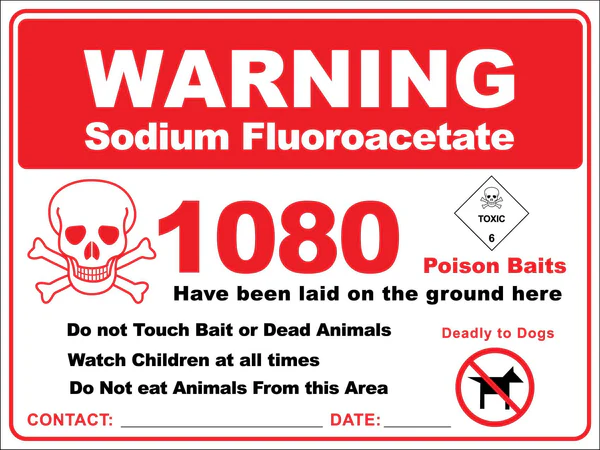
1080 has been the backbone of broadscale feral pig baiting in Australia for decades, and for good reason: it is highly effective and cheap. In NSW, Local Land Services often supplies 1080 grain and baits free to accredited landholders, and subsidised PIGOUT baits have been offered at around 60 cents each. When you need to knock down a large, dispersed population across a landscape at low cost, 1080 remains the tool most programmes are built on.
It works by blocking the cellular energy cycle, shutting down the heart and brain. The catch is that this takes longer than sodium nitrite, four to six hours to kill, and can involve retching, vomiting, and frenzied behaviour along the way, which is why it rates lower on humaneness. It also has no reliable antidote.
The risk that matters most to farmers is to working dogs. 1080 is lethal to dogs, and a pig that vomits after eating a bait can spread the toxin over a wide area where a dog or a native animal may find it. If you run dogs or bait near houses and stock, this risk has to be managed carefully. Our guide on protecting working dogs from 1080 baiting covers how.
Finally, 1080 is tightly controlled. You need a current VPIT certificate or AQF3 Chemical Accreditation to handle it, and in NSW only Local Land Services can supply it. VPIT is free, online, and valid for five years, so the accreditation is easy to get, but it is a step HOGGONE does not require.
The Honest Comparison
Neither bait is simply better. They trade off along a few clear lines.
- Humaneness and speed: HOGGONE wins. It acts faster and rates as more humane.
- Cost: 1080 wins, usually decisively, especially with free LLS supply.
- Non-target and dog safety: HOGGONE wins, thanks to fast metabolism, the Hoghopper, and an antidote.
- Ease of access: HOGGONE wins for the individual landholder (no accreditation), while 1080 comes with the benefit of coordinated, subsidised LLS programmes.
- Broadscale coverage: 1080 is the established landscape workhorse, though HOGGONE is closing the gap.
A practical way to think about it: reach for HOGGONE when non-target safety, working dogs, or humaneness are your priority, or when you want to bait without getting accredited. Reach for 1080 when cost and broadscale coverage matter most and you can manage the dog risk, particularly inside a coordinated LLS programme.
Why the Bait Is Only Part of the Answer
Whichever bait you choose, baiting alone will not solve a pig problem. Feral pigs breed fast, a population can rebound within 12 to 18 months if pressure stops, and pigs can grow shy of any single bait. The best results come from using baiting as one part of a coordinated programme that also includes trapping near stock and houses and thermal-assisted ground shooting to clean up the survivors, run across neighbouring properties at the same time so pigs cannot simply reinvade from next door.
Proper free-feeding matters more than the brand on the bait. Laying non-toxic bait first, to build the mob’s confidence so they feed readily when the toxic bait goes out, is the difference between a 90 percent result and an expensive failure with either product.
How We Help
We hold VPIT certification and use both HOGGONE and 1080 as part of our baiting programmes, matched to your property. We assess where pigs are feeding, watering, and harbouring, choose the right bait for the risk, run the free-feeding properly, and combine baiting with trapping and ground shooting so the result actually holds. See our feral pig control page for how the pieces fit together, or get in touch for a plan built around your country.
Sources consulted: APVMA product registration 85027 (HOGGONE meSN); PestSmart national Standard Operating Procedures NATSOP-PIG006 (HOGGONE sodium nitrite) and NATSOP-PIG004 (1080); RSPCA Knowledgebase on sodium nitrite and 1080; Animal Control Technologies Australia (HOGGONE meSN and PIGOUT); Centre for Invasive Species Solutions; Sharp and Saunders Relative Humaneness Matrix (2011); NSW Government guidance on using 1080 baits and VPIT; Local Land Services.