The Numbers That Don’t Add Up
The NSW Government has invested $40 million and culled nearly 250,000 feral pigs over three years. Agriculture Minister Tara Moriarty says the program is “culling more pigs than ever before.”
NSW Farmers Association president Xavier Martin sees it differently: “This isn’t the blitz we need to see, it’s barely a few bits of bacon.”
Both are telling the truth. The investment is real. The effort is genuine. And the maths shows it is nowhere near enough.
Here is why. Nearly 250,000 pigs culled over three years works out to roughly 80,000 per year. Published research establishes that you need to remove 70 to 80 percent of a feral pig population annually just to hold numbers steady. Australia has an estimated 13 to 24 million feral pigs nationally. Even a conservative estimate puts the NSW share at several million.
At 80,000 removals per year, the current program is operating at roughly 1 to 2 percent of the rate needed to suppress population growth. The pigs are breeding faster than they are being killed. And under favourable conditions, populations can grow by up to 80 percent in a single year.
Nationals Shadow Agriculture Minister Brendan Moylan put it bluntly: “If nearly 250,000 pigs have been culled and the problem is still this bad, it tells you the current approach is nowhere near enough.”
What $40 Million Has Achieved
None of this is to dismiss the effort. The $40 million investment, part of a broader $1 billion biosecurity program protecting a $25 billion primary industries sector, has delivered tangible results.
A single aerial operation west of Dubbo at Mungery and Dandaloo removed 2,276 pigs over five days across 149,000 hectares. Three aerial programs have run in that area since 2023. Across the state, 17 more aerial shooting operations are planned over the coming months. More than 2 tonnes of baited grain have been provided to landholders since 2023.
The problem is not that the government is doing nothing. The problem is that the biology of feral pigs makes anything short of sustained, landscape-scale, integrated control a losing equation.
As Invasive Species Council CEO Jack Gough said: “The issue we have is not a lack of knowledge. The issue is a lack of funding and a lack of strategy.”
What Farmers Are Seeing on the Ground
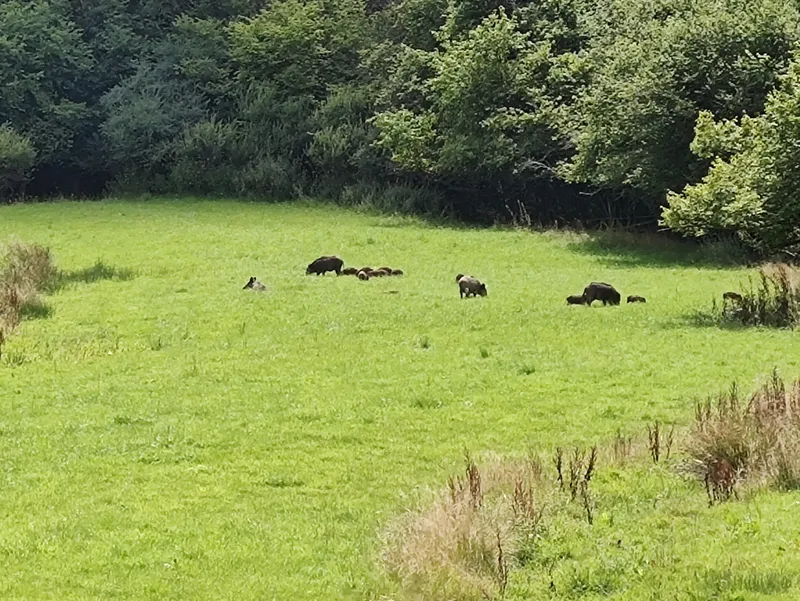
Photo: TheFurther21, CC-BY-SA-4.0, via Wikimedia Commons
The statistics tell one story. Individual farmers tell a harder one.
$55,000 in Lambs Gone in a Season
Neville Mattick runs sheep at Hargraves in the Central West. In 2021, his lambing rate was 118 percent. By 2025, it had collapsed to less than one percent. Feral pigs were taking every lamb.
“I’m hamstrung at the moment of being able to do anything, because we’ve not, again, sold a lamb this year. $55,000 worth of lambs, which have been mopped up.”
“It’s not something I’m proud of. No farmer like me, multi-generational, wants to be the generation that fails.”
He trapped every pig he could before lambing began. The moment the first lamb dropped, the pigs stopped going into the traps and started taking lambs instead. He is now considering abandoning sheep for cattle.
”The Scrub Is Chock-a-Block Full”
Josh Borowski farms near Coonamble in the North West. He lost 40 percent of his lupin crop, 60 percent of his barley, and entire chickpea plantings to pigs that “basically will uproot an entire chickpea crop, shovelled up the whole crop and taken the seed.”
“You’re constantly cleaning feeders, it’s just a lot more work. Not to mention you’re out shooting every night.”
“It’s getting above us and really taking a margin, not in a small way.”
30 to 40 Pigs in a Day Is Normal
Tim Vincent near Tamworth has watched the situation deteriorate over a decade: “Ten years ago, you’d catch three pigs and that was good; these days, you could catch up to 30 or 40 in a day, and that’s normal.”
The daily time cost alone is significant: “Laying traps and shooting takes one person two or three hours every day.” That is 15 to 20 hours a week on pig management, on top of running a farm.
30 Hectares of Canola Overnight
Chris Maunder runs 6,000 hectares near Moree. Pigs “came in from the west in huge numbers” one night and destroyed 30 hectares of canola. No warning, no defence.
These are not exceptional stories. Every farmer in the North West, Northern Tablelands, and Central West has a version of them.
Why 250,000 Culled Is Not Enough: The Biology
Feral pigs breed faster than almost any other large pest animal in Australia. Understanding their biology explains why the current control effort, despite being the largest in NSW history, is falling short.
Breeding rate: Sows can reach sexual maturity at six months old. They produce litters of 4 to 10 piglets, with up to two litters per year. Under good conditions, a feral pig population can grow by 80 percent in a single year.
Recovery speed: A 2024 study published in Biological Invasions found that feral pig populations recovered to pre-trapping levels in as little as 3 to 5 months after trapping operations ceased. Earlier Australian field estimates put the recovery time at 12 to 18 months after a 70 percent knockdown, but the recent science suggests it can happen much faster.
The 70 percent threshold: Published research (Hone, 2012) shows that 60 to 70 percent of the population must be removed continuously throughout the year to hold numbers stable. Not to reduce them. Just to stop them growing.
Compensatory breeding: Populations subjected to control can compensate with increased fertility and survival rates, actively speeding recovery. Removing pigs creates more food and space for survivors, which then breed more successfully.
What this means for NSW: If the state has 5 million feral pigs (a rough extrapolation from national estimates), suppression requires removing 3.5 to 4 million per year. The current 80,000 per year is roughly 2 percent of what is needed. The arithmetic is not a criticism of effort. It is a description of the biological reality that feral pig management must confront.
The Regional Picture
The crisis is not evenly distributed. Some regions bear a far heavier burden.
North West NSW: $62 Million in Damage
An economic impact study by AgEcon for North West Local Land Services found that feral pigs caused an estimated $62.35 million in agricultural losses across the region in winter 2022 and summer 2022 to 2023. That figure was up 10.3 percent from the previous year, despite increased management spending by landholders.
The study covered 13 agricultural enterprises across 466,304 hectares. The LLS objective to reduce production losses by 10 percent was not achieved.
In the Gwydir region alone (around Moree), 60,000 feral pigs were shot in 2024 to 2025 according to Grain Central reporting. The estimated damage across the full Moree district was $4.5 million. Population doubling time in the region: 12 months under good conditions.
Cotton growers reported yield losses of 2 to 5 percent, translating to roughly $250 per hectare across 4,000 hectares. Exclusion fencing costs $25,000 per kilometre.
The National Parks Problem
Across NSW, farmers consistently point to one issue: feral pigs breed unchecked on public land and then raid neighbouring private properties.
Lyndon Barry, farming south of Braidwood, described it plainly: “Every good bit of ground gets trashed, and they’re all coming from one place, the State Conservation Area.”
Renard Saunders near Tinderry added: “If the government was to collaborate a bit better, people wouldn’t be letting these private shooters out as much, because it’d be largely taken care of.”
Beef Central reported that zero prosecutions had been made against public land managers for pest management failures over a seven-year period.
Other States Are Scaling Up Too
The crisis extends beyond NSW. Queensland released a Draft Feral Pig Management Action Plan 2026 to 2031 in February, backed by a $50 million biosecurity commitment. Feral pig impact in Queensland was estimated at $95 million in 2023.
Victoria announced $2.75 million in March 2026 for feral pig control across 1.1 million hectares of eastern Victoria, following community pressure from farmers in the high country.
The Disease Time Bomb
Beyond agricultural damage, feral pigs represent a massive biosecurity risk that could dwarf current losses.
African Swine Fever
African Swine Fever has been detected in Papua New Guinea, Indonesia, and Timor-Leste. It is present across Southeast Asia. ABARES modelling shows the potential cost to Australia:
| Scenario | Estimated Cost |
|---|---|
| Small outbreak in feral pigs, eradicated | $101-127 million over 5 years |
| Small outbreak in domestic pigs | $117-263 million |
| ASF becomes endemic in feral pig population | $0.82-2.54 billion over 30 years |
ABARES estimated a 21 percent probability of ASF detection in Australia within five years.
Australia’s 13 to 24 million feral pigs represent the largest uncontrolled reservoir for ASF in any developed country. If the virus reaches feral pig populations, eradication becomes dramatically more expensive and potentially impossible. Every feral pig roaming your property is a potential carrier.
Japanese Encephalitis
Japanese encephalitis virus has been confirmed in feral and domestic pigs across an expanding range of NSW local government areas since December 2024. The virus passes from pigs to humans through mosquitoes, and feral pigs act as amplifying hosts that keep the virus circulating in the environment. Free JEV vaccines are now available in affected areas, including Armidale, Bathurst, and the Tweed. For farmers working around feral pigs and standing water, the health risk is real and growing.
The Review: What Dr Clift Is Looking At
In March 2026, Agriculture Minister Tara Moriarty tasked Independent Biosecurity Commissioner Dr Katherine Clift with reviewing feral pig and deer management in NSW. The review covers:
- The best available tools and techniques for controlling feral pigs and deer at regional scale, including new and emerging technologies
- Challenges delivering control programs across diverse landscapes and land tenures
- Methods to increase landholder participation and biosecurity compliance
Preliminary advice is due in June 2026. The final report is expected in October 2026.
The review follows a separate $1 million Natural Resources Commission review, raising questions about duplication. Nick Savage from NSW Farmers commented: “The perception that actions to date have been effective are plainly wrong.”
The political tension is captured by Moylan: “While the government congratulates itself on ‘coordination frameworks’ and ‘strategic reviews,’ pigs are multiplying at a rate that would make Treasury blush.”
Moriarty’s position is that the review “will help refine how public and private land managers work together, ensuring control programs are consistent, practical and responsive to local needs.” She acknowledged that “feral pigs and pests are not a problem for government alone, everyone needs to work together.”
What farmers want from the review is straightforward: sustained long-term funding, access to national parks for coordinated control, and removal rates that actually match the biology.
What Actually Works at Scale
The maths is daunting but not hopeless. Successful feral pig management exists. It requires three things the current approach often lacks: integration, coordination, and persistence.
Integrated Methods, Not Just Shooting
The PestSmart national best practice guidelines are clear: bait before you shoot. Shooting first scatters pigs and makes them bait-shy. The correct sequence is:
- Survey the property with thermal drone flights and trail cameras to understand where pigs are, how many there are, and what routes they use
- Bait with 1080 or HOGGONE through species-specific feeders that exclude livestock
- Trap using corral traps with remote camera monitoring to target remaining mobs
- Shoot survivors through coordinated ground and aerial operations
- Monitor with cameras and follow-up surveys to measure results and detect reinvasion
Each method alone achieves a temporary local reduction. Applied in sequence, they multiply each other’s effectiveness.
Coordinated Across Properties
Andrew Knight from NSW Farmers Warrumbungle Branch put it simply: “The pigs are not dumb; they figure out what poison is and what traps are. You need more tools to attack.”
And those tools need to be applied across property boundaries. Pigs pushed off one farm resettle on the next. Coordinated programs that cover entire landscapes, including Crown land and national parks, deliver far greater impact than isolated efforts on individual properties.
The NW NSW LLS achieved this in the Western Riverina demonstration site, reducing feral pig density from 11.6 pigs per square kilometre to 0.6. That is a 95 percent reduction. It required coordinated effort across the entire landscape, not just individual properties.
Sustained Over Time
The 3 to 5 month recovery window means that one-off operations, no matter how intensive, are temporary. Seasonal programs that maintain pressure across autumn and spring, with monitoring between campaigns, prevent the population from bouncing back.
As the Grain Central data shows, 60,000 pigs shot in the Gwydir region in a single year did not prevent population growth because the effort was not sustained at the required intensity across the entire landscape.
The Bigger Picture
Feral pig management spending by individual farms has risen 39.5 percent in six years, from $7,480 per farm in 2016 to $10,434 in 2022 according to ABARES. The national total: $3.8 billion per year spent by farmers on vertebrate pests and weeds, with $1.5 billion in production losses.
These numbers will continue to climb unless removal rates approach the biological threshold. No amount of money spent at current intensity will solve the problem. The biology does not negotiate.
The Clift review is an opportunity to reshape how NSW approaches feral pig management. Whether the government uses it to increase the intensity and coordination of control, or treats it as another report to file, will determine whether the numbers on the ground change.
Ted Rowley, Chair of the National Deer Planning Committee, described the trajectory in terms that apply equally to pigs: “They are becoming Australia’s next rabbit plague.”
That is not inevitable. The Western Riverina demonstration achieved a 95 percent reduction. It can be done. But it requires the scale of effort and coordination that the maths demands, not the scale of effort that fits a media release.
Need Help With Feral Pig Control?
If feral pigs are costing you production, sleep, and sanity, Feral Up runs coordinated control programs across NSW using thermal drone surveys, 1080 and HOGGONE baiting, trapping, and professional ground shooting. We work with neighbouring properties to deliver landscape-scale results, not isolated efforts that pigs walk around.
Get in touch for a no-obligation chat about what a coordinated program would look like for your property and your neighbours.