A New Feral Deer Species Has Been Found in NSW
In March 2026, trail camera footage confirmed what biosecurity officers had feared. Feral hog deer, a species never before recorded in the wild in NSW, were detected between Blayney and Yass on the Southern and Central Tablelands.
The animals were first reported through the FeralScan DeerScan app, which alerted Local Land Services and NSW DPIRD biosecurity officers to the incursion. Trail cameras then confirmed the species.
Invasive Species Council CEO Jack Gough did not mince words: “This is a biosecurity emergency, this is not just another deer sighting, this is an entirely new species that operates in different ways.”
NSW DPIRD vertebrate pests biosecurity acting manager Nathan Cutter confirmed that professional contractors have been identified to support farmers, and that the department considers the population “still small enough for eradication to be a feasible outcome.”
The window to act is now. Below is everything NSW farmers need to know about hog deer: what they are, how to spot them, where they came from, and what to do about them.
What Is a Hog Deer?
Hog deer (Axis porcinus) are the smallest feral deer species in Australia. They were introduced from South Asia in the 1800s and until recently were confined to a small population along Victoria’s Gippsland coast.
Size: Males weigh up to 55 kg and stand about 70 cm at the shoulder. Females are smaller at 25 to 30 kg and 60 cm. To put that in perspective, a hog deer stag is roughly one quarter the weight of a sambar stag.
Coat: Uniform yellow-brown to red-brown. Some cream spotting appears during summer. Young calves have white spots that fade as they mature.
Antlers: Small, reaching only 35 cm, with three tines on each side. Males shed and regrow antlers annually.
The name: Hog deer run through forest and scrub with their heads low, ducking under obstacles rather than jumping over them, much like a pig. This distinctive running style is how they got their name.
Behaviour: Mostly solitary, unlike herding species such as fallow and chital. They prefer dense vegetation near waterways, wetlands, and coastal scrub. When disturbed, they become nocturnal. They rarely venture into open paddocks during daylight.
How Hog Deer Compare to Other NSW Feral Deer
NSW already deals with five established feral deer species. Hog deer are different in several important ways.
| Feature | Hog Deer | Fallow Deer | Red Deer | Sambar | Chital |
|---|---|---|---|---|---|
| Weight (male) | 55 kg | 60-100 kg | 160 kg | 230 kg | 85 kg |
| Shoulder height | 70 cm | 95 cm | 120 cm | 130 cm | 90 cm |
| Social | Solitary | Herds | Herds | Solitary | Herds |
| Habitat | Dense cover, wetlands | Semi-open scrub | Open woodland | Dense forest | Warm grassland |
| Visibility | Very low | Moderate | Moderate | Low | High |
| Detection difficulty | Very hard | Moderate | Moderate | Hard | Easy |
The key difference for farmers is detection. Fallow and chital deer form herds in relatively open country, so you see them. Hog deer are solitary, stick to thick cover, and run low rather than bolting into the open. Leah Samson, coordinator at Gunning Landcare, put it plainly: “Deer can be so much more elusive than pigs, you’re not necessarily seeing massive disturbances associated with them.”
Their droppings add another challenge. Hog deer produce small cylindrical pellets that closely resemble sheep faeces. On a property running sheep, you could walk past hog deer sign without a second glance.
How Did Hog Deer Get to NSW?
Until March 2026, the only established hog deer population in Australia was along Victoria’s southeastern coast in Gippsland. The Game Management Authority estimated approximately 4,252 hog deer in that region in 2023.
The Gippsland coast is more than 700 kilometres from the Blayney-Yass corridor where the NSW animals were found. Hog deer are not long-distance dispersers. Genetic research from the GMA found the Victorian population has low genetic diversity and consists of three distinct subpopulations, confirming limited natural movement even within Gippsland itself.
Two separate hog deer populations were detected in NSW. That rules out a single escape. Multiple release points indicate deliberate, planned translocation by people.
Jack Gough was direct about who is responsible: “Some hunters have, in an act of wanton and despicable selfishness, decided to move some of those deer into parts of NSW because they’ve decided that their recreation is more important than farming, our native wildlife, and our rivers.”
This Is Not a New Problem
Illegal translocation of feral animals for recreational hunting has been documented in Australia for decades. Academic research found that 58 percent of Australia’s 218 wild deer populations were established through illegal translocation.
In South Australia, DNA testing confirmed that feral pigs found on the Limestone Coast had been illegally imported from southern NSW. At one site near Kingston where 8 to 10 pigs were believed to have been released, the Limestone Coast Landscape Board trapped, shot, and poisoned close to 90 animals within 18 months.
Victoria controversially protects hog deer as a valued game species with strict hunting limits. The annual hog deer season runs for just one month (April), with a bag limit of one male and one female per hunter. One commercial outfitter in East Gippsland is fully booked through 2029. That demand and limited access likely drives the motivation for illegal translocation to NSW.
The Legal Position
Moving deer into NSW is a clear breach of the Biosecurity Regulation 2017, which prohibits dealings with deer including movement, keeping, and release. At the federal level, the Environment Protection and Biodiversity Conservation Act 1999 carries penalties of up to 10 years imprisonment and fines up to $210,000 for wildlife trade offences.
Despite documented cases across multiple states, no convictions for deer or pig translocation have been publicly reported.
Why This Matters for Farmers
Hog deer are small, but the consequences of an established population are not.
Population Growth
Without control, feral deer populations grow by 34 to 50 percent per year. The NSW Government’s own figures show that a modest herd of 30 deer can balloon to 500 within a decade. Nathan Cutter specifically warned that early intervention now “will prevent feral hog deer becoming a major issue, such as that posed by sambar deer” in Victoria.
Agricultural Damage
Feral deer cost Australian agriculture $69 million per year in production losses, according to the Centre for Invasive Species Solutions. The broader cost to communities and primary producers is $91.3 million annually.
Individual farm impacts tell a harder story. Cattle producer Mal Weston near Jindabyne estimates $100,000 per year in lost production from his cattle competing with deer. He shot 300 deer in 2016, 500 in 2017, and 900 in 2018. The numbers kept growing. One 81-hectare improved pasture block on his property now runs 15 cattle instead of 50.
Sandy Middleton in Tumbarumba described the impact in starker terms: “If you’re a heavily impacted farm that’s under heavy pressure you could be losing a third to a half of your rate.”
Disease Risk
Feral deer are potential carriers of diseases that threaten Australia’s livestock industries. The National Feral Deer Action Plan notes that a small foot-and-mouth disease outbreak (3 months) could cost $7.1 billion, while a large outbreak (12 months) could reach $16 billion. Every uncontrolled feral deer population increases the reservoir for disease transmission.
The Cost of Waiting
Ted Rowley, Chair of the National Deer Planning Committee, described feral deer as “becoming Australia’s next rabbit plague.” He noted that deer multiply by 45 percent per year, meaning you need to remove 45 percent of the population annually just to hold numbers steady.
The contrast between early eradication and ongoing management is stark. The SA Limestone Coast example shows what happens when a small release is caught early: intensive effort over 18 months to contain 90 animals from an original release of about 10. Now imagine that population discovered five years later, when those 10 animals have become hundreds.
Why Hog Deer Are Harder to Detect Than Other Deer
If you have fallow deer on your place, you know about it. They form mobs in the open and leave obvious tracks across paddocks.
Hog deer are different. They are built for hiding.
Dense cover: They prefer thick vegetation along waterways, wetlands, and scrubby creek lines. They rarely move into open country during daylight hours.
Solitary habits: Unlike fallow, chital, and red deer that form herds, hog deer are mostly solitary. You will not see a mob of 30 crossing a paddock.
Running style: Instead of bolting upright and jumping fences like other deer, hog deer run low through vegetation, ducking obstacles. This keeps them below your line of sight and makes them harder to spot even when disturbed.
Nocturnal when pressured: They shift to nocturnal activity when they detect human disturbance. If you have been shooting other deer on your property, any hog deer present may already be moving only at night.
Droppings mimic sheep: As Leah Samson from Gunning Landcare warned, “their poo looks like sheep, so they can be harder to detect.” On a property running livestock, hog deer sign blends into the background.
No obvious damage patterns: Unlike feral pigs that leave unmistakable rooting and wallowing, hog deer damage is more subtle. Victorian National Parks Association’s Jordan Crook described the species as a “little bulldozer” despite its small size, but the evidence is harder to spot. Browsed vegetation and game trails through dense scrub are the main signs, not the torn-up paddocks that pigs leave behind.
How to Identify Hog Deer on Your Property
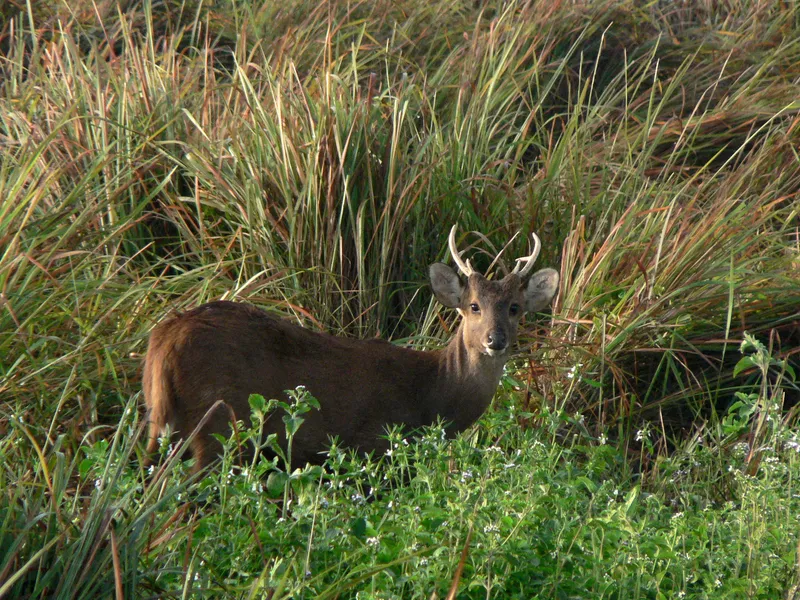
Photo: T. R. Shankar Raman, CC-BY-SA-4.0, via Wikimedia Commons
Physical Signs to Look For
Tracks: Small cloven hoof prints, noticeably smaller than fallow or red deer. Look along creek banks, around dams, and on muddy tracks through dense vegetation.
Droppings: Small cylindrical pellets, 10 to 15 mm long. Similar in size and shape to sheep droppings. Look for concentrations along game trails and near water rather than in open paddocks.
Browse: Hog deer eat young grasses, leaves, flowers, and fallen fruit. Browse marks will be lower than other deer species (below 70 cm) due to their short stature.
Game trails: Low, narrow tracks through dense scrub, especially along creek lines and through wetland vegetation. These will be lower and narrower than trails made by larger deer species.
Best Detection Methods
Trail cameras are the most reliable tool. Place them:
- On game trails through dense vegetation along waterways
- At dam edges and stock watering points
- Along fence lines where scrub meets open paddocks
- At 50 to 70 cm height (lower than you would set for other deer)
Set cameras to trigger on motion with a short interval between shots. Hog deer move quickly through the frame because of their low, fast running style.
Thermal drone surveys can detect hog deer in dense vegetation that would be impossible to search on foot. The SA PIRSA trial found that thermal-assisted aerial operations detected 72 percent of pigs and 53 percent of deer in dense canopy that were invisible from the ground.
Check your trail camera footage carefully. At first glance on a grainy night-time image, a hog deer could be mistaken for a large fox, a small kangaroo, or even a dog. Their low profile and quick movement make identification harder than with larger deer.
What to Do If You Find Hog Deer
1. Report immediately
Use the FeralScan DeerScan app (free, available on iOS and Android). Include:
- Exact location (GPS coordinates or property description)
- Date and time of sighting
- Photos or trail camera footage
- Number of animals seen
- Any sign found (tracks, droppings, browse)
All data submitted through FeralScan is confidential and only accessible to registered control groups. Reporting does not expose your property details publicly.
2. Contact Local Land Services
Call your local LLS office directly. Hog deer are listed as a priority pest species throughout the South East LLS region, and biosecurity officers are actively monitoring for new reports.
3. Do not attempt solo eradication
Individual shooting might remove one animal but can scatter others and push them onto neighbouring properties. The current DPIRD strategy is coordinated eradication across the landscape. Nathan Cutter confirmed that “professional contractors have been identified to support farmers.” Working with those contractors gives you access to thermal equipment, coordinated effort, and the landscape-scale approach that eradication requires.
4. Set up monitoring
If you are in the Southern Tablelands, Central West, or any area adjacent to the Blayney-Yass corridor, consider deploying trail cameras on your property even if you have not seen deer. Early detection on your place could be the difference between eradication and a permanent new pest population.
NSW’s Growing Deer Problem
The hog deer incursion comes at a time when NSW is already struggling with its existing feral deer populations.
Over the past four years, government coordinated control operations removed almost 34,000 feral deer from NSW, including more than 15,000 from July 2024 to June 2025. In March 2026, NSW Agriculture Minister Tara Moriarty tasked the Independent Biosecurity Commissioner, Dr Katherine Clift, with investigating ways to improve feral pig and deer management. The NSW Government has invested $40 million into feral animal management over the past three years.
Despite those numbers, deer populations continue to grow across the Hunter Valley, Northern Tablelands, North Coast, and Southern Tablelands. The National Feral Deer Action Plan, backed by more than $8 million in federal funding, sets out 22 actions nationally. One of its core objectives is to “control or eradicate small isolated populations before they spread.” The hog deer detection is exactly the scenario that objective was written for.
The Independent Biosecurity Commissioner’s preliminary report is due in June 2026, with the final report in October. For hog deer, waiting for a report is not an option. The eradication window is open now.
What Effective Control Looks Like
Jack Gough made the point clearly: “Getting on top of populations when they’re small and geographically confined is the best way to deal with this. It only happens when governments and landholders work together with professional shooters, using all the control tools in the toolbox, including aerial shooting with thermal scopes.”
Hog deer control requires methods suited to their behaviour:
Thermal drone surveys to locate animals in dense vegetation before committing ground crews. Standard spotlighting will miss hog deer because they shelter in thick cover and do not come into the open.
Professional ground shooting with thermal optics for targeted removal once animals are located. The SA PIRSA trial found that thermal-assisted operations doubled the cull rate compared to visual methods, with a zero percent wounding rate.
Trail camera networks for ongoing monitoring. Cameras confirm presence, track movement patterns, and verify whether eradication efforts are working.
Coordinated, landscape-scale effort across neighbouring properties. Hog deer pushed off one property will settle on the next. Effective eradication means working across property boundaries, not in isolation.
This is not a job for recreational hunters. As Mal Weston’s experience shows, even shooting 900 deer in a single year did not stop population growth. Recreational hunting is selective, inconsistent, and works against eradication by maintaining populations at huntable levels. Peter Jacobs from the Invasive Species Council put it simply: “Recreational deer hunting has clearly failed to control numbers.”
What You Can Do Right Now
Whether you are in the Blayney-Yass corridor or anywhere else in NSW, these steps apply.
If you are in the Southern Tablelands or Central West:
- Deploy trail cameras along waterways, creek lines, and dense vegetation on your property
- Check footage regularly and learn what hog deer look like compared to other deer, foxes, and livestock
- Report any unfamiliar deer sighting through FeralScan DeerScan immediately
- Talk to your neighbours about what they have seen
- Contact your Local Land Services office to register your interest in coordinated control
If you are in the Hunter Valley, Northern Tablelands, North Coast, or elsewhere in NSW:
- Be aware that illegal translocation can happen anywhere. Two separate populations found between Blayney and Yass means someone is actively moving these animals.
- If you see a deer smaller than a fallow, solitary, and running low through scrub rather than jumping, report it.
- Review your existing trail camera footage for animals you may have dismissed as foxes or dismissed entirely.
The difference between a few animals and a permanent population is time. Every report matters.
Need Help With Deer Detection or Control?
Feral Up provides professional feral deer detection and control across NSW using thermal drone surveys, trail camera networks, and coordinated ground shooting programs. If you suspect hog deer or any feral deer on your property, get in touch for a no-obligation discussion about what a detection and monitoring program would look like for your place.